

The best ceiling fan for most homes is the Hunter Key Biscayne 52-inch: a traditional, well-built fan with a reversible motor, an LED light kit and a damp rating, at a mainstream price. It suits bedrooms and living rooms, it moves plenty of air for a medium or large room, and it looks like a fixture rather than an appliance. But “most homes” is not your home. A low ceiling needs a flush mount, a great room needs a 60- or 72-inch span, a covered patio needs a wet or damp rating, and a light sleeper needs a quiet DC motor. The 10 picks below cover every one of those situations — overall, value, everyday, style, budget, low ceilings, premium smart, smart airflow, outdoor and large-room value — each with the room it suits, the features that matter, and the trade-offs to know before you buy.
Prices below are retailer checks from October 2026 roundups; prices change, so check the current retailer listing before you buy.
How To Choose The Best Ceiling Fan?
Four decisions narrow the field from hundreds of fans to a handful. Work through them in order, and the right pick usually chooses itself.
Size First: Match The Blade Span To The Room
A fan that is too small runs at full speed all day and still leaves corners still; a fan that is too big overwhelms a small room and looks wrong. Use the room’s area as the guide.
| Room Size | Blade Span To Choose |
|---|---|
| Up to 75 sq ft (small bedroom, office) | 29–36 inches |
| 76–144 sq ft (bedroom, study) | 36–42 inches |
| 144–225 sq ft (living room, primary bedroom) | 44–50 inches |
| 225–400 sq ft (large living room, open plan) | 50–54 inches |
| Over 400 sq ft (great room, vaulted space) | 60 inches and up |
A standard 12-by-12-foot room takes a 52-inch fan comfortably. For the bedroom specifically, our [ceiling fan sizing guide](/what-size-ceiling-fan-for-bedroom/) works through the same numbers room by room, so this list can stay focused on the picks.
Airflow Second: Read The CFM, Not The Motor Size
CFM — cubic feet per minute — is the honest measure of how much air a fan moves. Look for at least 4,000 CFM for a bedroom and 6,000 or more for a living room or open-plan space. A big blade span with a low CFM is a decoration; a smaller fan with a high CFM is doing real work.
Motor Third: DC Beats AC For Most Buyers Now
DC brushless motors use far less electricity than older AC motors — roughly 15 to 35 watts against 60 to 90 watts at the same airflow — and they run quieter at low speeds, switch direction smoothly, and usually offer more speed steps. AC motors are cheaper and still fine in a basic fan, but if the fan will run every night in a bedroom, a DC motor is worth paying for.
Mounting And Light Fourth
Flush-mount (low-profile) fans sit close to the ceiling and suit 8-foot ceilings; downrod fans need 9 feet or more, and the blades should hang 7 to 9 feet above the floor. A fan with an integrated LED light replaces a ceiling fixture; a fan without a light suits rooms that already have good lighting. Check whether the light is dimmable and whether its color temperature can change — a 2700K warm light suits evenings, a 4000K neutral suits daytime.
One Safety Note Before You Buy
A ceiling fan must hang from a fan-rated ceiling box, not a standard light-fixture box. If you are replacing a light with a fan, check the box first — swapping it is a small job, but hanging a fan from a light box is not safe. If the wiring or the box is in doubt, an electrician is the right call.
1. Hunter Key Biscayne 52-Inch — Best Overall
The Hunter Key Biscayne is the fan to buy when you want one answer and you want it to be right. This Old House picked it as the best overall ceiling fan after reviewing more than 50 models and reading over 300 customer reviews, and the reasons are plain: a traditional, classic design that fits almost any decor, a multi-speed reversible motor that delivers strong, quiet airflow to medium and large rooms, and an LED light kit included in the box.
Who it suits: bedrooms and living rooms up to about 225 square feet, and anyone who wants a fan that looks like part of the room rather than a gadget on the ceiling. The weathered zinc finish and five-blade shape sit comfortably in traditional, transitional and coastal rooms alike — in a [cozy living room](/cozy-living-room-ideas/), it reads as part of the furniture, not as an appliance bolted on after the fact.
Key features: 52-inch blade span, reversible motor for summer downdraft and winter updraft, LED light kit, pull-chain control, and a damp rating — so it can also go on a covered porch. Hunter backs the motor with a limited lifetime warranty.
The trade-offs: there is no remote in the box, so you control it by pull chain unless you add one, and a few reviewers found it noisier than expected at high speed. Airflow is strong for the price but not the strongest in this list — the smart and large-room picks below move more air.
Tip: if you like the Key Biscayne but want remote control from day one, budget for Hunter’s add-on remote kit at the same time. Adding it later means another trip up the ladder.

2. Hunter Builder Deluxe 52-Inch — Best Value
The Hunter Builder Deluxe is the boring, correct answer — the fan reviewers keep recommending when someone asks for good airflow and a quiet motor without paying for features they will never use. This Old House named it the best value pick, and its reviewers praise the WhisperWind motor for quiet running, with one buyer calling it “absolutely dead quiet” at every speed.
Who it suits: homeowners who want a traditionally designed, well-built fan for a bedroom, living room or dining room, at a price well below the style-led picks. It is the fan to buy five of when you are fitting out a whole house — and reviewers report doing exactly that.
Key features: 52-inch span, five blades, multi-speed reversible motor, LED bow light kit, bronze or brushed nickel finishes, and a low-profile design that sits closer to the ceiling than many 52-inch fans. Hunter’s limited lifetime motor warranty applies here too.
The trade-offs: the light uses candelabra bulbs and several reviewers found the light output underwhelming for a room that needs real illumination. Some users also reported difficult installation and occasional noise. It is a fan first and a light second — if the room needs its main light from the fan, look at the DREO Low Profile or the Minka-Aire Light Wave instead.
Tip: the Builder Deluxe is height-adjustable, so it works on standard and slightly lower ceilings. Measure your ceiling height before you order the downrod — the right drop keeps the blades in the 7-to-9-foot zone above the floor.

3. Hunter Builder Plus 52-Inch — Best Everyday Pick
The Hunter Builder Plus is the safe pick for most rooms: a 52-inch, five-blade fan with a reversible motor, three bulbs in the light kit, and a 4.7-star average across more than 4,700 ratings in an October 2026 price check, when it was listed at $179.99. It is the fan you buy when you do not want to think about ceiling fans again for a decade.
Who it suits: most rooms in most homes — bedrooms, living rooms, home offices — especially when you are replacing an older fan and want something that simply works. It pairs well with a higher thermostat setting in summer, because the moving air lets the room feel cooler than the thermostat says.
Key features: 52-inch span, reversible motor for year-round use, three-bulb light kit, pull-chain control, and quiet operation that reviewers single out for bedrooms. The hanging height is about 18 inches, so it suits standard 8- to 9-foot ceilings.
The trade-offs: no remote control — pull chain only — and the styling is plain by design. If the fan is the visual centerpiece of a living room, the Minka-Aire Light Wave below earns its premium; if the fan just needs to work, the Builder Plus is the better spend.
Tip: check the current retailer listing before you buy — the $179.99 figure is an October 2026 check, and Hunter runs frequent promotions that move the price in both directions.

4. Minka-Aire Light Wave 52-Inch — Best For Style And Living Rooms
The Minka-Aire Light Wave is the fan that reviewers buy when the fan has to look designed, not just work. It came out on top in Consumer Reports’ lab tests of 52-inch fans — strong in every test and quiet on high — and it appears as the style pick in nearly every serious roundup. The wave-moulded blades and glass shade read as a light fixture first and a fan second.
Who it suits: living rooms where the fan is visible from the sofa and the entry, and buyers who want premium build quality and exceptional airflow without going to a smart fan. It is the pick for the room guests see first.
Key features: 52-inch span, three blades in distressed Koa wood, reversible motor, dimmable LED light kit with a warm, soft glow, and energy-efficient LED lighting. In an October 2026 price check it was listed at $379.99 — roughly twice the Builder Plus — which is the premium you pay for the design and the test results.
The trade-offs: the price, plainly. It is also a three-blade fan, so it moves air differently from a five-blade model — strong, but with a different feel at low speed. And the styling is distinctive: if your room is rustic or farmhouse, the Honeywell Carnegie or the Parrot Uncle windmill style may fit better.
Tip: the Light Wave’s dimmable LED is a genuine asset in a living room that doubles as a TV room. Dim the light low in the evening and the fan disappears into the ceiling — which is exactly what a good living room fan should do.

5. Hunter Anisten 52-Inch — Best Budget Bedroom Fan
The Hunter Anisten is the low-cost way into a dependable 52-inch fan with a light: matte black, five blades, an LED light kit with bulbs included, and a reversible motor — listed at $119.99 in an October 2026 price check, with a 4.2-star average. It replaces older budget Hunter models that are no longer sold, and it keeps the parts that mattered.
Who it suits: bedrooms, home offices and guest rooms where the budget is tight but the fan still needs to be quiet and reliable. It is also a sensible pick for a rental or a first home, where you want a real fan rather than the cheapest thing on the shelf.
Key features: 52-inch span, LED light kit with bulbs included, pull-chain control, reversible motor for all seasons, and a matte black finish that suits modern and transitional rooms. The price leaves room in the budget for a fan-rated box or an electrician if the ceiling needs one.
The trade-offs: no remote, standard mount only, and the styling is plain. The light is adequate rather than generous — if the bedroom has no other light source, budget for a bedside lamp or a brighter fixture as well.
Tip: at this price, check that the box includes everything the listing promises — bulbs, downrod and mounting hardware — before the installer arrives. Budget fans sometimes vary by retailer on what is in the box.

6. Hunter Anslee 46-Inch — Best For Low Ceilings
The Hunter Anslee is a low-profile 46-inch fan built for rooms where a standard fan would hang too low: 8-foot ceilings, bedrooms, kitchens and studies where headroom matters. It was listed at $149.99 in an October 2026 price check, with a 4.4-star average across nearly 1,700 ratings — the best-rated low-ceiling pick in its roundup.
Who it suits: any room with an 8-foot ceiling, and especially bedrooms where the fan sits over the bed. The 46-inch span covers rooms up to about 144 square feet without crowding them, and the low-profile housing keeps the blades well above head height.
Key features: 46-inch span, low-profile flush-style mount, multi-speed motor, reversible blades, soft LED lights in a shaped white casing, and a 13-degree blade pitch that moves air efficiently for the motor size. The design is compact and neat rather than decorative.
The trade-offs: a 46-inch fan will not cool a large living room — it is a small-to-medium-room tool, and using it in a great room means running it at full speed for little effect. It is also not the pick for high or vaulted ceilings, where a downrod model belongs.
Tip: for a [bedroom ceiling](/bedroom-ceiling-ideas/) with a fan, keep the blades at least 7 feet above the floor and 18 inches from the walls. The Anslee’s low profile makes that easy on an 8-foot ceiling, but measure the drop before you buy — “low profile” still needs the right clearance.

7. Big Ass Fans Haiku L — Best Premium Smart Fan
The Big Ass Fans Haiku L is the most capable smart fan in this list, and the most expensive by a wide margin — listed in a $800 to $950 range in 2026 smart-fan roundups. What justifies the price is not the airflow alone but the intelligence: its SenseME system senses room occupancy and temperature, runs only when someone is in the room, and syncs with Nest or Ecobee thermostats to coordinate cooling.
Who it suits: primary bedrooms, home offices and living rooms in a smart home, where the fan should think for itself — and buyers who will actually use the automation rather than just the app. If you want a fan that adjusts to the room instead of waiting for you to adjust it, this is the one.
Key features: 52- or 60-inch span, aerospace-grade composite blades, DC motor drawing about 32 watts on high, seven speed settings, remote control, app control, and native support for Alexa, Google Home and Apple HomeKit. The 10-year limited warranty is the longest here.
The trade-offs: the price is hard to justify for a secondary room, and the full feature set needs the Big Ass Fans app. Some reviewers also found it less quiet than expected at high speed. This is a fan for one important room, not for the whole house.
Tip: pair the Haiku with a smart thermostat. The fan lets you raise the thermostat set point by several degrees without losing comfort, because moving air cools skin directly — and the thermostat manages the whole system. Bought together, the pair saves more than either does alone.
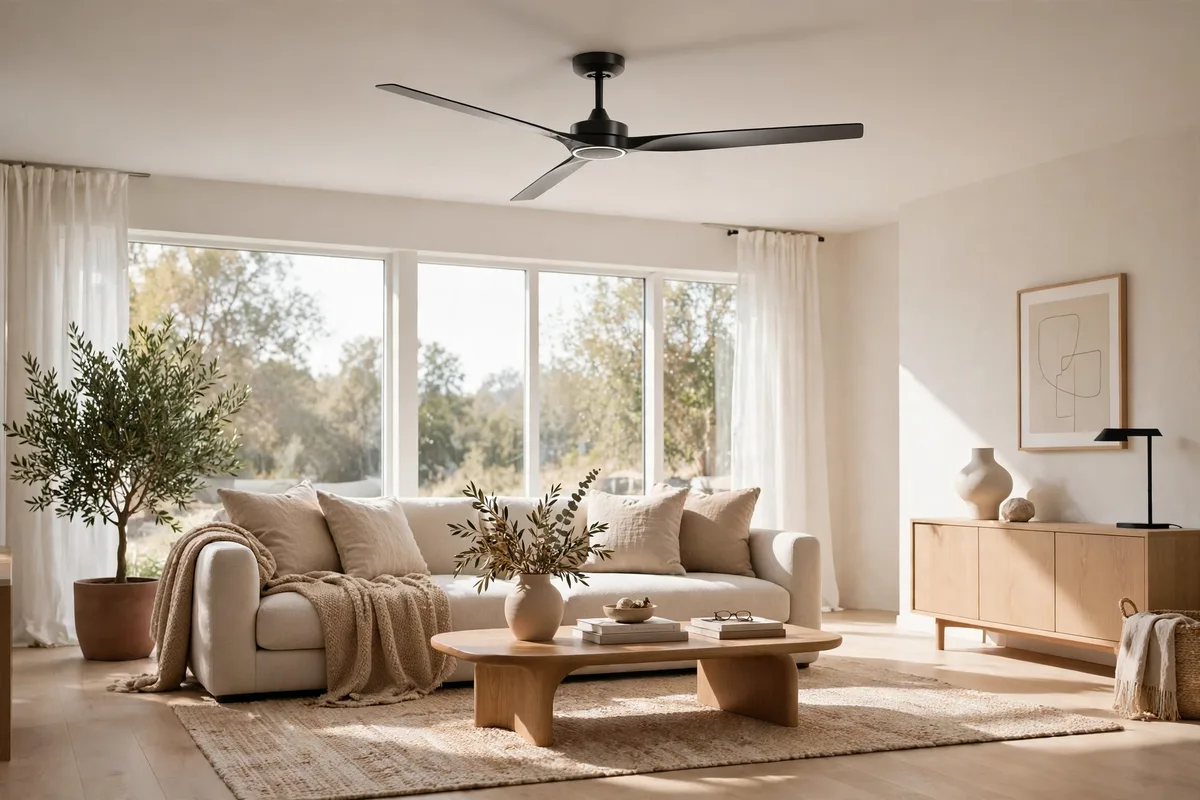
8. DREO Smart 52-Inch — Best Smart Fan For Airflow And Value
The DREO Smart 52-inch is the most technologically complete fan in the mid-price range: a 12-speed DC motor, app and voice control, three wind modes, and the highest airflow in its comparison group — a peak of 5,673 CFM, driven by a 14-degree blade pitch. It is the smart fan to buy when you want the features of the Haiku without the Haiku’s price.
Who it suits: smart-home owners who want granular control — Alexa or Google Home voice commands, a “Goodnight” scene that dims the light and drops the fan to speed two, a sleep timer up to 12 hours — and anyone who wants maximum airflow from a standard 52-inch fan.
Key features: 52-inch span, 12 speeds plus Natural, Normal and Sleep wind modes, brushless DC motor, stepless light temperature from 2700K warm to 6500K daylight with brightness from 1 to 100 percent, memory function, and a preassembled design that keeps installation under 30 minutes for most buyers.
The trade-offs: the blades are ABS plastic rather than engineered wood, so the feel is less premium than the Minka-Aire picks. There is no wall switch in the box — control is by remote or app — and the light, while flexible, is a single integrated module rather than replaceable bulbs.
Tip: use the sleep timer and the memory function together: set the fan to drop to a low speed after you fall asleep, and it will remember your settings after a power cut. Light sleepers get the airflow without the 3 a.m. chill.

9. Minka-Aire Xtreme H2O 65-Inch — Best For Covered Outdoor Spaces
The Minka-Aire Xtreme H2O is the outdoor pick: a 65-inch smart fan built for covered patios and screened porches, with an IP44 moisture rating that handles humidity and light rain without corroding, and a rated airflow of 7,200 CFM — enough to cool a 300-square-foot covered patio.
Who it suits: covered patios, screened porches and outdoor entertaining spaces in humid climates, where an indoor fan would corrode and a cheap outdoor fan would give up in a season. The 65-inch span covers a real outdoor living area, not just the chairs nearest the fan.
Key features: 65-inch span, eight engineered wood blades, quiet DC motor with six speeds, Wi-Fi control with Alexa and Google Home, and a wet-location build that stands up to outdoor use. In 2026 smart-fan roundups it was listed in a $280 to $340 range — a premium over indoor fans, but reasonable for what it is built to survive.
The trade-offs: it is an outdoor-only use case at that price, and there is no HomeKit support. The size also demands a proper mount: a covered patio ceiling needs a fan-rated box just as much as an indoor ceiling does, and the fan is heavy enough that the box rating matters.
Tip: an outdoor fan does not cool the air — it moves it across skin, which is what makes a hot patio feel bearable. Pair the Xtreme H2O with shade and it will do more for comfort than any misting system at the same price.

10. Home Decorators Collection Kensgrove 72-Inch — Best Large Rooms On A Budget
The Kensgrove 72-inch is the large-room bargain: eight maple blades, a handheld remote that controls fan speed and light dimming independently, and a price of $109.99 in an October 2026 check — less than most 52-inch fans — with a 4.5-star average across nearly 1,000 ratings. It is the fan for a great room, a vaulted living room or an open-plan space that needs one big fan instead of two small ones.
Who it suits: owners of large rooms, vaulted spaces and open-concept great rooms who want one fan to handle the whole area on a budget. The espresso bronze finish and eight-blade design read as a statement fixture, and the weather-resistant blades suit covered outdoor spaces too.
Key features: 72-inch span, eight maple blades, remote control with independent speed and light dimming, concealed screws and coupling covers for a clean look, and a downrod mount that suits higher ceilings.
The trade-offs: installation is not easy — reviewers flag it as the hardest install in its roundup — and the sheer size will overpower any room under about 225 square feet. It is a big-room tool, and using it in a small room is a mistake, not a bargain.
Tip: measure twice before you order a 72-inch fan: the blades need 18 inches of clearance from the walls, and the ceiling needs to be high enough for the downrod plus the fan body while keeping the blades 7 to 9 feet above the floor. In a room with a 9-foot ceiling, a 72-inch fan fits; in an 8-foot room, it does not.

The 10 Best Ceiling Fans Compared
| Pick | Best For | Size | Motor | Light | Price Check |
|---|---|---|---|---|---|
| Hunter Key Biscayne | Overall | 52 in | AC reversible | LED included | Check current listing |
| Hunter Builder Deluxe | Value | 52 in | AC WhisperWind | LED bow kit | Check current listing |
| Hunter Builder Plus | Everyday rooms | 52 in | AC reversible | 3-bulb kit | $179.99, Oct 2026 |
| Minka-Aire Light Wave | Style, living rooms | 52 in | Reversible | Dimmable LED | $379.99, Oct 2026 |
| Hunter Anisten | Budget bedroom | 52 in | AC reversible | LED, bulbs incl. | $119.99, Oct 2026 |
| Hunter Anslee | Low ceilings | 46 in | Multi-speed | Soft LED | $149.99, Oct 2026 |
| Big Ass Fans Haiku L | Premium smart | 52/60 in | DC, 32W | Smart LED | $800–$950 range, 2026 |
| DREO Smart | Smart airflow | 52 in | DC, 12-speed | 2700–6500K LED | Check current listing |
| Minka-Aire Xtreme H2O | Covered outdoor | 65 in | DC, 6-speed | Wi-Fi smart | $280–$340 range, 2026 |
| Kensgrove | Large rooms, budget | 72 in | Reversible | Remote dimming | $109.99, Oct 2026 |
Prices are retailer checks from October 2026 roundups, not live quotes — they move with promotions and stock, so check the current retailer listing before you buy. If a price looks very different from the one here, the listing may be a different finish or a newer revision of the same model.
How To Install A Ceiling Fan Without Regret?
A good fan installed badly is a bad fan. Four checks before the box opens save most of the trouble: confirm the ceiling box is fan-rated and will hold the fan’s weight; confirm the wiring includes a neutral wire if the fan is smart — older homes sometimes lack one at the ceiling; download the app and pair the fan on the bench before it goes nine feet overhead; and check the blade clearance — 7 to 9 feet above the floor, 18 inches from the walls. If any of those checks fails, fix it before the install, not during it.
For the full comparison behind several of these picks, This Old House’s guide to the best ceiling fans — built from more than 50 models and 300 customer reviews — is a useful second opinion, and it names the same Hunter Key Biscayne as its best overall.
Frequently Asked Questions
What Size Ceiling Fan Do I Need For My Room?
Match the blade span to the room’s area: 29–36 inches up to 75 square feet, 36–42 inches for 76–144 square feet, 44–50 inches for 144–225 square feet, 50–54 inches for 225–400 square feet, and 60 inches or more above 400 square feet. A standard 12-by-12-foot room takes a 52-inch fan. Our [ceiling fan sizing guide](/what-size-ceiling-fan-for-bedroom/) covers bedrooms in detail, including low ceilings and sloped ceilings.
Are DC Motor Ceiling Fans Worth It?
For most buyers, yes — especially in bedrooms. DC motors use roughly half to two-thirds less electricity than AC motors at the same airflow, run quieter at low speeds, and usually offer more speed steps and smoother reversing. The premium is modest on most mid-price fans now, and it pays back in quiet nights and lower running costs. For a fan that runs occasionally in a guest room, an AC motor is still fine.
Do Ceiling Fans Actually Cool A Room?
A ceiling fan does not lower the room’s air temperature the way an air conditioner does. It moves air across your skin, which makes you feel cooler — the wind-chill effect — so you can raise the thermostat a few degrees without losing comfort. That is why a fan and a smart thermostat work so well together. In winter, reverse the fan to push warm air down from the ceiling.
What Is The Quietest Ceiling Fan For A Bedroom?
Look for a DC motor, a noise rating under 35 dB at low speed, and a well-balanced blade set. In this list, the Hunter Builder Deluxe (WhisperWind motor) and the Hunter Anslee are the quietest bets, with the addlon 42-inch flush mount also testing at 35 dB in its roundup. Whatever you buy, balance the blades after installation — most wobble and hum comes from an unbalanced blade, not a bad motor.
Can I Use An Indoor Ceiling Fan Outside?
Only if it is rated for it. Indoor fans corrode quickly in humidity. For a covered patio or screened porch, use a damp-rated fan like the Hunter Key Biscayne or a wet-rated fan like the Minka-Aire Xtreme H2O. A fan for an uncovered pergola needs a true wet rating — an IP65 rating or equivalent — and a covered-porch fan will not survive direct rain.
The right ceiling fan is the one that fits your room, your ceiling and your habits — not the one with the longest spec sheet. Start with the size table, pick the situation that matches your room, and buy the fan built for that situation. A 52-inch Hunter in a bedroom, a 72-inch Kensgrove in a great room, a quiet DC fan over the bed: each of those is a better buy than the most expensive fan hung in the wrong room.