

A tank water heater keeps 40 to 50 gallons hot around the clock, so you get a limited amount of hot water at any flow rate. A tankless water heater heats water only as it flows through, so you get unlimited hot water at a limited flow rate. Those two sentences are the whole comparison in miniature, and everything else — cost, efficiency, lifespan, maintenance — follows from them.
Tankless is the better buy if you plan to stay in your home for years, want hot water that never runs out, and your house already has (or can affordably get) the gas line, venting, or electrical capacity it needs. A tank is the better buy if you want the lowest upfront cost and a simple like-for-like swap, you run several hot fixtures at once, or your home would need major gas or electrical upgrades to support tankless. The rest of this guide walks through each factor so you can match the choice to your own house, not to a sales pitch.
How A Tank Water Heater Works?
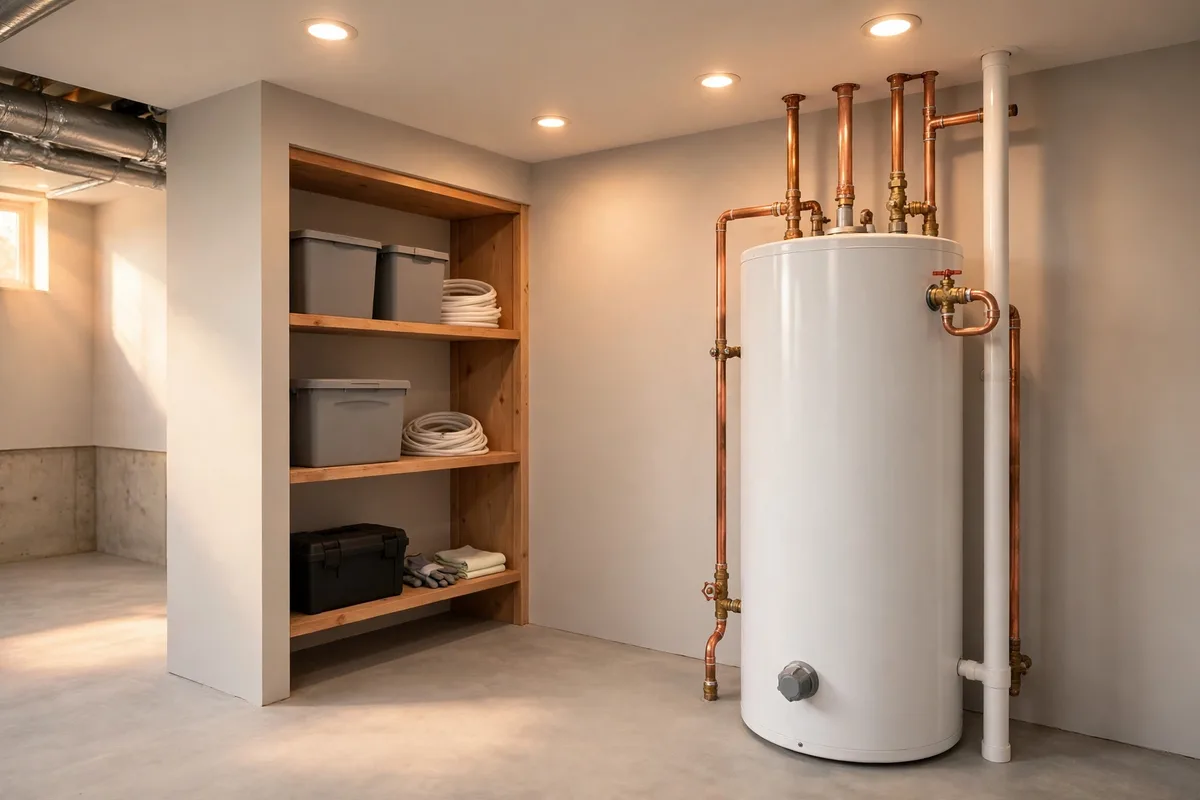
A tank water heater is the tall cylinder most homes already have. Cold water enters at the bottom, a gas burner or electric element heats it, and the hot water sits at the top, ready for the next shower. A thermostat keeps the whole tank at your set temperature, usually around 120°F, whether anyone is using hot water or not.
That readiness is the tank’s strength and its weakness. You always have hot water waiting, but the heater spends energy keeping 40 to 50 gallons hot through the night, through the workday, and through a two-week holiday. This is called standby heat loss, and it is the main reason a tank costs more to run than its efficiency rating suggests. When you drain the tank faster than it can reheat — three showers back to back, then a load of laundry — the water runs cold and you wait for the recovery.
Tanks are simple, familiar technology. Nearly every plumber knows them, parts are widely available, and a like-for-like replacement is usually a one-day job because the gas, water, and venting connections are already in place.
How A Tankless Water Heater Works?
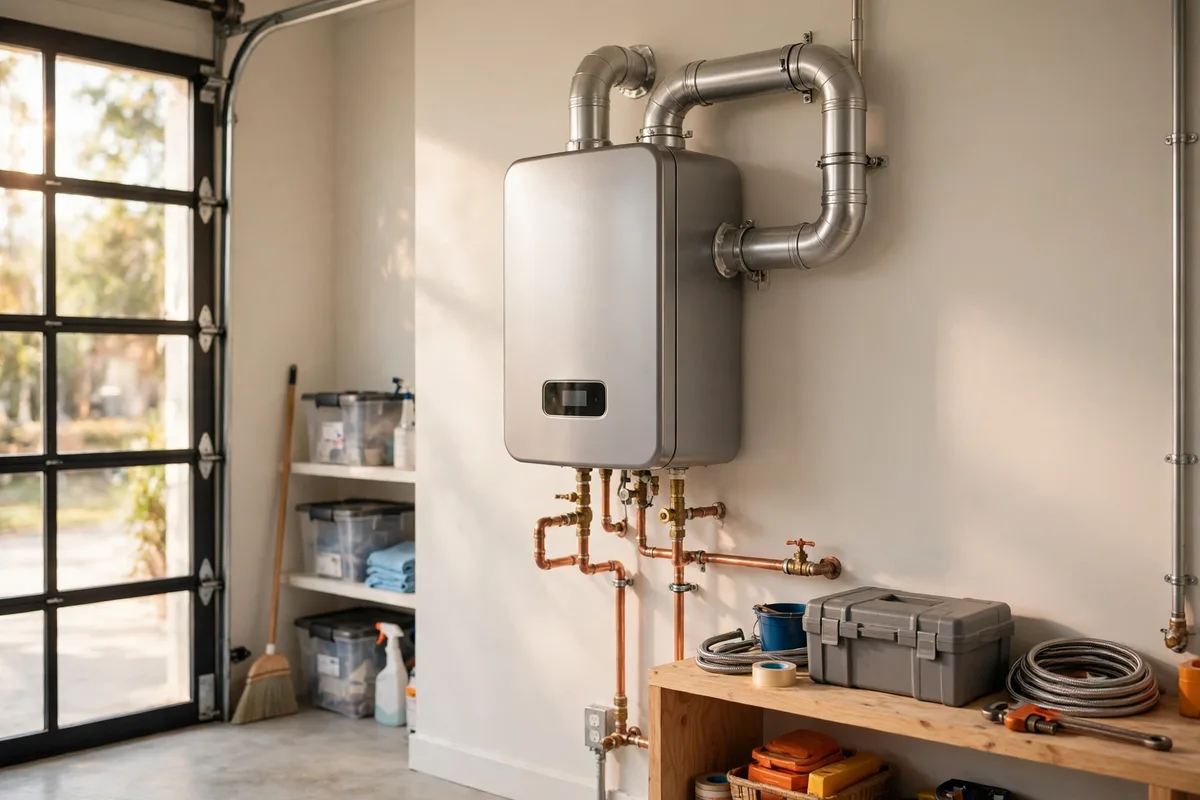
A tankless water heater, also called an on-demand water heater, stores nothing. When you open a hot tap, a flow sensor detects the water moving and a powerful gas burner or electric element heats it as it passes through a heat exchanger. Close the tap and the heating stops. There is no tank losing heat between uses, so standby loss drops to near zero.
The trade-off is flow rate. A tankless unit can only heat so many gallons per minute. A single gas unit typically delivers about 2 to 5 gallons per minute, roughly one shower plus one other fixture. Push past that and the water either cools off or the unit throttles the flow to hold its temperature. A tankless heater never runs out over time, but it can run short at one moment if too many taps are open at once.
Tankless units are compact boxes, about the size of a carry-on suitcase, that mount on a wall. They need a gas line big enough for a much larger burner, their own venting, and electricity for the controls and fan — even the gas models.
Tank Vs Tankless Water Heater At A Glance
| Factor | Tank Water Heater | Tankless Water Heater |
|---|---|---|
| How it works | Stores 30–80 gallons hot around the clock | Heats water only while a tap is open |
| Upfront installed cost | Lower, roughly $1,200–$2,500 like-for-like | Higher, roughly $3,000–$6,000 to convert from a tank |
| Energy efficiency | Loses heat all day (standby loss) | 24–34% more efficient at 41 gal/day or less; 8–14% at about 86 gal/day (U.S. DOE) |
| Hot water supply | Limited by tank size; can run out | Continuous, limited by flow rate (about 2–5 GPM) |
| Lifespan | About 10–15 years | 20+ years with regular descaling |
| Maintenance | Yearly flush; anode rod check | Yearly descaling; inlet filter cleaning |
| Space | Floor space for the tank | Small wall-mounted unit |
| Power outage | Many gas tanks with a standing pilot keep working | Needs electricity, including gas models |
| Best for | Lowest upfront cost, several fixtures at once, quick swap | Long stays, endless hot water, tight space |
Cost ranges are typical US ballpark figures from published contractor and cost-guide sources; your quotes will vary by region, brand, and how much your home needs. Always get two or three written quotes before deciding.
Upfront Cost And Installation
A tank replacement is usually the cheaper job by a wide margin. Swap a 50-gallon gas tank for another 50-gallon gas tank and the plumbing, gas supply, and venting are often already right. The work is straightforward, and the heater is back on the same day.
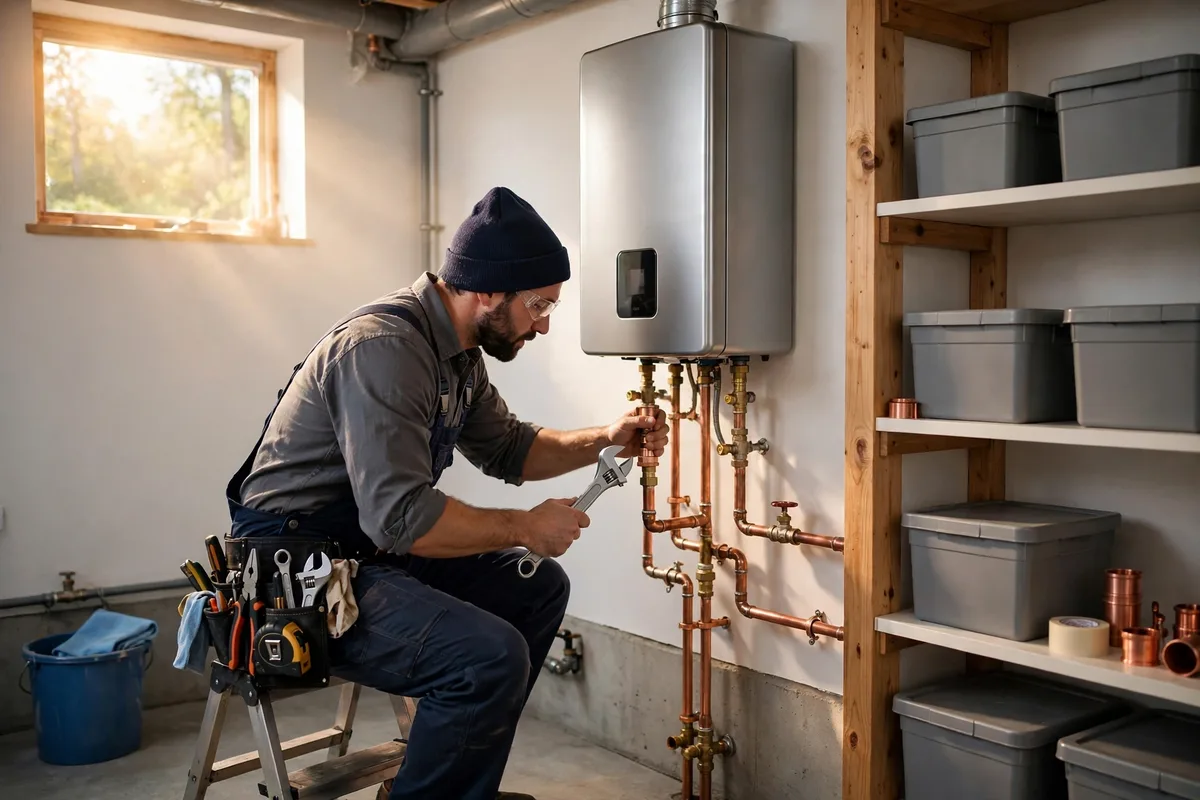
Switching from a tank to tankless is a different job. A gas tankless unit needs a larger gas line, because its burner is several times more powerful than a tank’s. It needs new venting — stainless steel for standard models, or PVC for condensing models — routed to an exterior wall. It needs an electrical outlet for its controls, a condensate drain if it is a condensing model, and wall mounting on a load-bearing wall. Whole-home electric tankless units can draw over 100 amps, which may mean a panel upgrade. Permits are commonly required when the gas line, venting, or heater type changes.
That is why comparing the price tags of the two appliances is misleading. The number that matters is the installed cost, including the conversion work. Ask for the gas line, venting, electrical, and permit items broken out in the quote so you can see what the switch really costs in your house.
Tip: If you are already remodeling and the gas and electrical work is happening anyway, the tankless conversion premium shrinks a lot. A remodel is the cheapest moment to switch.
Energy Use And Running Costs
A tankless heater wins on efficiency, but by less than the marketing suggests. According to the U.S. Department of Energy, tankless heaters are 24% to 34% more energy efficient than conventional storage tanks in homes that use 41 gallons of hot water a day or less, and 8% to 14% more efficient in homes that use around 86 gallons a day. The bigger the household, the smaller the advantage, because a busy household keeps a tank working hard anyway and gives standby loss less room to matter.
In dollars, ENERGY STAR estimates a certified gas tankless water heater saves a family of four about $95 per year compared with a standard gas tank. That is real money, but it does not repay a $2,000-plus installation premium on its own — the payback on energy savings alone works out to roughly two decades. What can tip the math is lifespan: a tankless unit that lasts 20-plus years means buying one unit instead of two tanks over the same period. If you move within five years, you pay the full premium and the next owner gets most of the benefit.
The honest way to run the numbers is to compare your own quotes, not national averages. Take the installed-price difference, divide it by your expected yearly saving, and ask whether you will still be in the house when that number of years passes.
Hot Water Supply: Running Out Vs Running Short?
This is the difference most families actually feel. With a tank, you have a fixed amount ready. A family that showers back to back in the morning, then runs the dishwasher, can empty it — and then everyone waits while it reheats. A larger tank or a higher first-hour rating helps, but the limit is always the stored volume.
With a tankless unit, you do not run out over time. A twenty-minute shower is the same temperature at minute twenty as at minute one. But you can run short at one moment: two showers plus the washing machine can exceed a single unit’s flow rate, especially in winter when the incoming water is colder and the heater has to work harder to reach temperature. The fix is careful sizing — adding up the flow of every fixture you might run at once during your busiest moment — or, for large households, a second unit.
A Good Rule Of Thumb
If your complaint is “the hot water runs out halfway through the third shower,” tankless can help. If your complaint is “the shower goes cold when someone starts the dishwasher,” the fix is careful sizing, whichever type you choose. Sizing matters more than the type on the box, and a best shower head with a lower flow rate can ease the load on either system.
Lifespan
A tank typically lasts about 10 to 15 years, and a tankless unit 20 years or more, both with proper maintenance, according to the U.S. Department of Energy. A neglected tank can fail in 7 or 8 years, and a tankless unit that skips its descaling can lose years off its life. As a rough guide, one tankless unit usually outlasts one and a half to two storage tanks — which is exactly why the long-term cost math can favor tankless even when the yearly energy saving looks small.
Maintenance And Hard Water
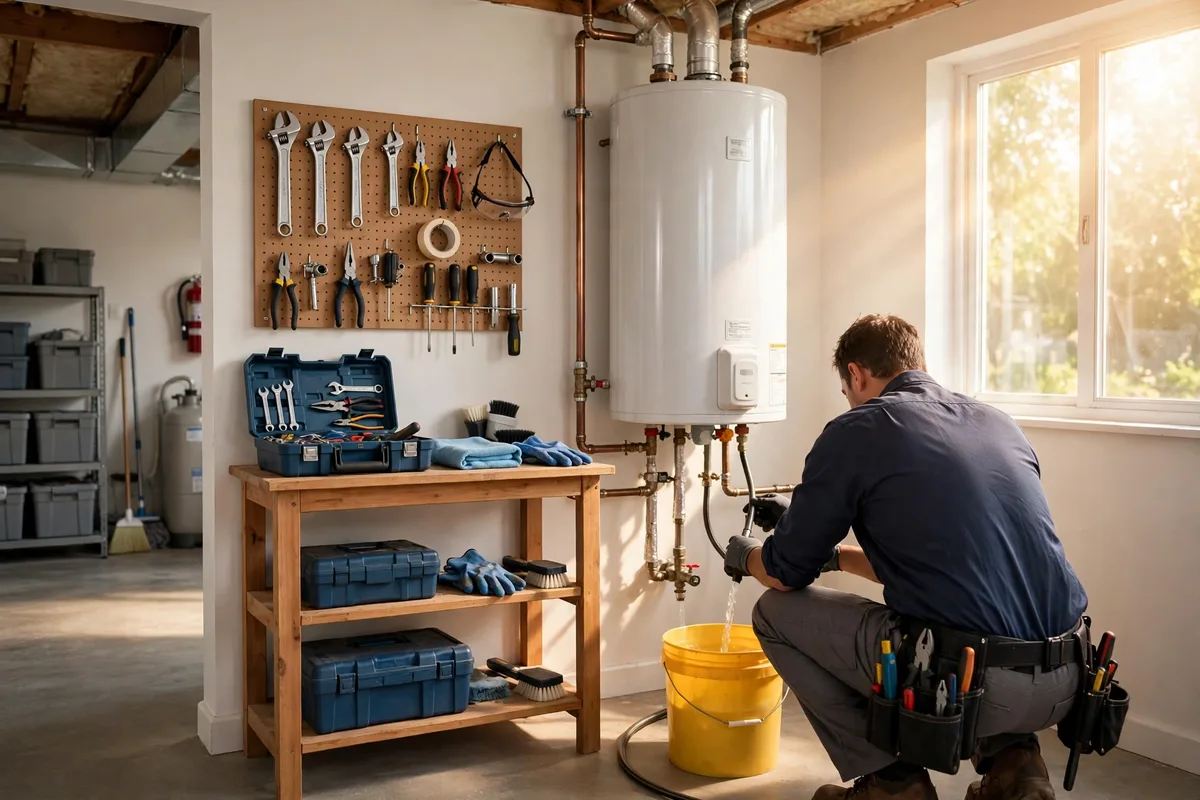
Neither system is maintenance-free, and the chores are different. A tank needs a yearly flush to clear sediment from the bottom, a check of the anode rod that protects the steel tank from corrosion, and a test of the temperature and pressure relief valve. The anode rod is the part most owners never hear about: it corrodes so the tank does not, and replacing it on time can add years to a tank’s life.
A tankless unit needs yearly descaling — circulating a descaling solution through the heat exchanger to dissolve mineral scale — plus cleaning the inlet water filter and checking the burner, vents, and sensors. In hard-water areas, descaling may be needed every six months. Scale is the tankless unit’s biggest enemy: it coats the narrow passages of the heat exchanger, cuts flow, and can trigger error shutdowns. A tank suffers from hard water too, as sediment settling on the bottom, but the effect is slower and more forgiving.
Tip: If your water is hard, budget for treatment or a strict descaling schedule before you choose tankless. A water softener ahead of the heater protects either type, but for tankless it is close to essential.
Space And Where It Goes
A tankless unit wins this category outright. A conventional tank occupies floor space — usually a corner of the garage, basement, or utility closet — while a tankless unit hangs on a wall and frees that floor for storage or living space. In a small home, a condo, or a finished basement, that reclaimed square footage has real value.
There are two catches. First, a gas tankless unit needs to be near an exterior wall for venting, so the old tank’s spot in the middle of the basement may not work. Second, a tankless unit still needs clearances around it for service access, so measure before you assume the space is fully yours. If you are rethinking the room itself, our basement ideas show how the freed floor space can be put to use.
Power Outages And Hot Water Wait Time
Two differences most comparison guides skip. First, power: many modern gas tankless systems need electricity for their electronic controls, ignition, and venting fan, so a power outage can leave you without hot water even though the gas is still on. Some traditional gas tanks with a standing pilot light and non-powered venting keep working through an outage because they do not need household electricity. A tank also holds a reserve — 40 or 50 gallons of hot water that stays warm for a while even if the heating stops. A tankless unit has no reserve at all.
Second, wait time: tankless does not mean instant hot water. The water still has to travel from the heater through the pipes to your tap, and a tankless unit takes a moment to detect flow and start heating. If the heater sits far from the bathroom, switching to tankless will not shorten the wait. A recirculation system can help, but it adds cost and complexity, and an always-on loop can wear a tankless unit faster.
Which One Should You Choose?
| Your situation | Better fit | Why |
|---|---|---|
| 1–2 people, gas available | Gas tankless | Low daily use is where tankless saves the most; one unit easily covers a shower plus a sink |
| 3–4 people, gas available | Gas tankless (180,000–199,000 BTU) or a 50-gallon tank | Two showers at once is the sizing test; a large gas tankless usually handles it |
| 5+ people, frequent simultaneous use | Large tank, two tankless units, or tankless plus buffer tank | Peak demand can exceed one tankless unit’s flow rate |
| Large soaking tub | Tank, or a properly sized gas tankless | Fast tub fills demand high flow; some tankless units throttle flow to hold temperature |
| Selling within a few years | Tank | Lower installed cost; payback on tankless is long |
| Tight space, garage or closet needs room | Tankless | Wall-mounted, about the size of a carry-on suitcase |
| Hard water and no softener | Tank (or tankless with a softener) | Scale is harder on a tankless heat exchanger than on a tank |
| Remodel already in progress | Tankless | Gas and electrical work is already happening, so the conversion premium shrinks |
Gas line and electrical work are jobs for a licensed professional — never a DIY project. A gas line that is too small starves the burner, and wrong venting can create a carbon monoxide hazard. Get the sizing, the venting route, and the permit requirements in writing before any work starts, and check local code, since rules vary by area. If the switch is part of a bigger project, our guide on how much a bathroom remodel costs can help you budget the work around it.
What To Ask Before You Buy?
When you talk to an installer, ask these five questions before accepting a quote: how did you size this unit for my household; what venting, gas, or electrical changes does my home need; how hard is my water, and what does that mean for this heater; what upkeep does this model need, and how often; and what does the warranty cover, and for how long? A good installer answers all five before quoting. If the quote does not itemize the conversion work, ask for it itemized — that is where the surprises hide. For the smaller plumbing jobs around the house, such as a dripping tap, our guide on how to replace a faucet covers what a homeowner can safely do themselves.
The Bottom Line
There is no universal winner. A tank is cheaper, simpler, and handles several fixtures at once until its stored water runs out. A tankless unit costs more to install, uses less energy, lasts longer, and never runs out — as long as you stay within its flow rate. The right choice comes down to four things: how much hot water your household uses at the same time, how long you plan to stay, what your home’s gas and electrical setup can support, and how hard your water is. Answer those four honestly, get two or three itemized quotes, and the decision mostly makes itself.
Frequently Asked Questions
Is A Tankless Water Heater Worth It?
It depends mostly on how long you will stay. For gas, ENERGY STAR estimates a certified tankless unit saves a family of four about $95 a year, which does not cover the extra installation cost within the unit’s lifespan by itself. Because tankless units last about 20 years versus 10 to 15 for a tank, tankless can come out ahead over two decades by avoiding a second tank replacement. If you move within five years, a tank is usually the better buy.
Can A Tankless Water Heater Run Several Fixtures At Once?
It depends on the size of the unit and how cold the incoming water is. A single gas unit typically delivers 2 to 5 gallons per minute — about one shower plus one other fixture. Two showers plus a dishwasher can exceed that, especially in winter. Large households may need a larger unit, two units, or a tank.
Does A Tankless Water Heater Need Electricity?
Yes, including gas models. Modern tankless units need electricity for their electronic controls, ignition, and venting fan, so they stop making hot water during a power outage unless you have backup power. Some traditional gas tanks with a standing pilot light keep working through an outage.
How Often Does A Tankless Water Heater Need Descaling?
About once a year in most homes, and every six months where the water is hard. Skipping descaling lets mineral scale build up on the heat exchanger, which cuts flow and efficiency and can shorten the unit’s life. A tank needs a yearly flush instead, which is a simpler job.
Will A Tankless Water Heater Give Me Hot Water Faster?
Not necessarily. Hot water still has to travel through your pipes to reach the tap, and a tankless unit takes a moment to detect flow and start heating. If the heater is far from the bathroom, the wait stays the same. A recirculation system can shorten it, but it adds cost and complexity.
For efficiency ratings and certified models, see the U.S. Environmental Protection Agency’s ENERGY STAR water heater listings at ENERGY STAR Water Heaters.