
The best coffee table decor ideas do one simple thing: they make the table look considered without making it unusable. A guest should be able to set a mug down without moving anything, and the room should still look finished from the doorway. That is the whole test, and every idea below passes it.
Start with one group, not a shopping list. A tray with two books and a candle, a low bowl beside a small plant, or a single sculptural object on an otherwise clear table — any of these beats a crowded surface. The twelve ideas that follow work on their own, and they work better together, because each one answers a different question: what anchors the table, what adds height, what adds life, and what to do when the table is round, long, or glass.
Four Decisions Before You Place Anything
Before you buy or move a single object, settle four decisions. They take two minutes, and they stop most styling mistakes before they happen.
- Anchor: Choose one thing that defines where the group sits — a tray, a stack of books, or a low bowl. Everything else gathers around it.
- Height: Give the group one tall piece, one medium piece, and one low piece. Three different heights keep the table from reading as a flat row.
- Texture: Mix at least two materials. Wood against ceramic, glass against woven fibre, or stone against brass gives the eye something to notice.
- Empty Space: Leave at least a third of the table clear, in one usable stretch, not in crumbs of space between objects. That clear stretch is where mugs, books, and elbows actually live.
Designers return to the same advice again and again: fewer well-chosen pieces beat a full surface, and negative space counts as part of the design. Livingetc’s designer guide on how to style a coffee table makes the same point — when in doubt, take one thing away and look again. Keep that test in mind as you work through the list.
1. Anchor The Table With A Wooden Tray, Books, And A Candle
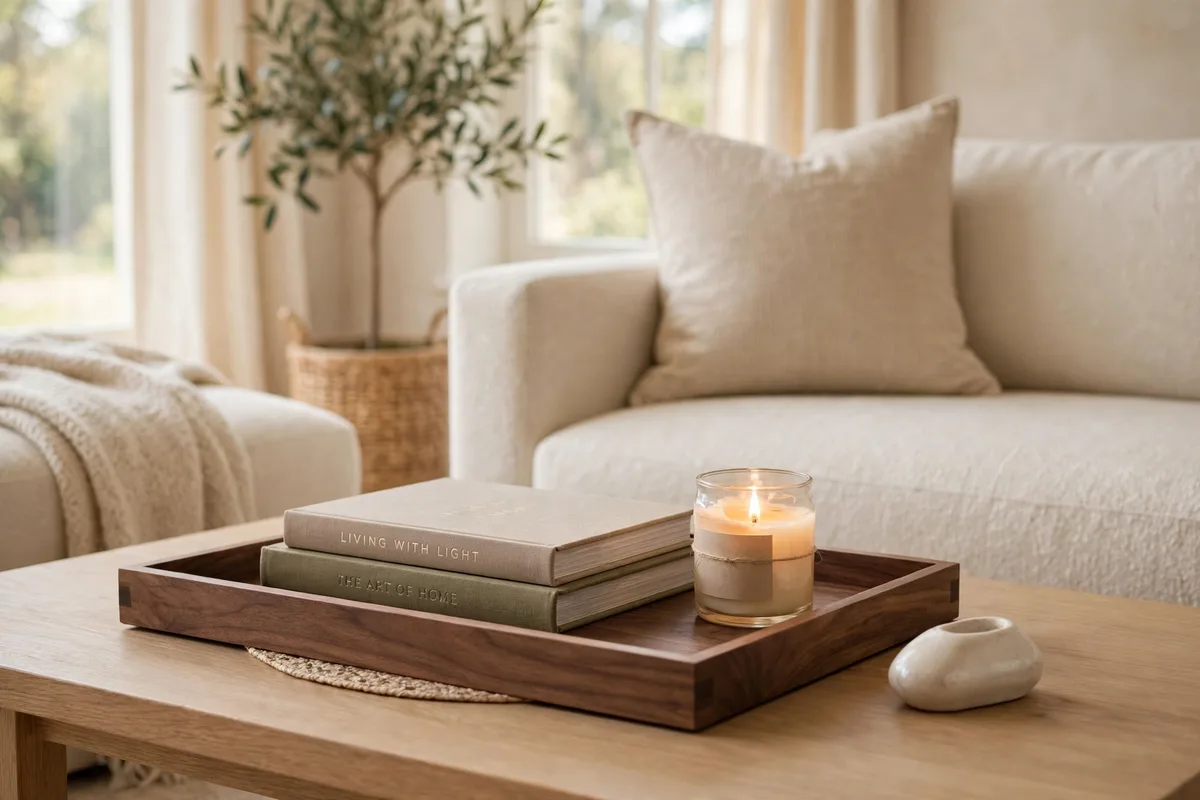
Start here if you start anywhere. A wooden tray holding two stacked books and a single candle is the most forgiving arrangement in this whole list, and it works on almost every table in almost every room.
The tray does the organizing. It draws a boundary around the group, so the books, the candle, and a small object read as one deliberate arrangement instead of three separate things that happened to land on the table. It also makes the whole group portable: lift the tray and the table clears in one move for a board game, a laptop, or dinner in front of the television.
Choose a tray that covers about a third of the table, never more than half. On a rectangular table, a round tray breaks up the straight lines nicely; on a round table, a rectangular tray can look awkward, so match the tray to the table or go round on round. Light oak suits pale rooms, walnut suits rooms with darker furniture, and a woven rattan tray softens a room full of hard surfaces.
Tip: Keep the candle in a jar or on a small coaster inside the tray, so wax and dust stay off the wood and the tray itself stays easy to wipe.
2. Stack Books With Intention, Not By Colour Alone

Books are furniture on a coffee table, not just reading material. A stack of two or three large books gives you height, colour, and a platform for smaller objects in a single move, which is why nearly every styled table in this list starts with one.
Stack the largest book at the bottom and the smallest at the top, and offset the edges slightly so each spine shows. Pick books someone in the room might genuinely open — art, photography, travel, interiors, or a subject the household actually cares about. A stack chosen only because every spine is beige looks obedient, not alive. Colour matters, but subject matters more: the top book is the one guests see, so let it say something about the people who live there.
Oversized art and design books work best as the base because they are wide enough to hold a bowl or a small vase on top. Two books are enough on a small table; three suit a standard table. If the stack starts to look like a pile, remove the top book and stop.
Tip: Rotate the top book with the season or when you finish a good one. It is the cheapest restyle in this list, and it costs nothing.
3. Cluster Candles At Three Different Heights

One candle is a detail. Three candles at different heights are a glow point. Group them tightly together — a tall taper in a slim holder, a medium pillar, and a low jar candle — and the table gains warmth and a reason to exist after dark.
Keep the cluster close, within a hand’s width of each other, because candles spread across the table look like a power cut, while clustered candles look like a plan. Use one scented candle at most; two competing scents argue with each other across a small room. Clear glass or pale ceramic holders blend into most rooms, while black or brass holders add contrast on a pale table.
Set the cluster on a tray or a stone coaster if your table is wood, and keep it clear of anything that can catch — dried branches, paper, or a fabric runner. Battery candles work well in the same grouping if the table sits near curtains or if children reach for it.
Tip: Light the candles in the evening even when nobody is visiting. A lit table changes the feel of the whole room faster than any other single move.
4. Add One Tall Vase With Branches For Height

Height is what stops a coffee table from looking flat, and a tall vase with branches is the simplest way to get it. One slim vase with eucalyptus, olive branches, or tall dried stems pulls the eye upward and breaks the long horizontal line of the sofa behind it.
Choose a vase that looks good empty, because some weeks it will be. Ceramic, textured stoneware, or smoked glass all work; the vase itself should carry some weight in the room, not just the stems. Keep the arrangement low enough that people can talk across the table without leaning around it — branches that fan out at eye level block conversation, while stems that rise above the sightline or stay below it do not.
Fresh stems last a week or two in water. Dried or preserved branches last for months and suit a table that gets styled once and left alone. Swap the stems when the season changes and the whole table feels new again.
Tip: Cut stems at different lengths so the arrangement fans out instead of standing in a stiff bunch, and strip any leaves that would sit below the waterline.
5. Set Down A Low Bowl For Everyday Things

A low bowl is the hardest-working object on this list. It holds the things a coffee table actually collects — remotes, coasters, a phone, a pair of reading glasses — and turns that clutter into a group with a boundary.
Pick a bowl wide enough to be useful and shallow enough to stay out of the sightline, roughly the size of a dinner plate or a little larger. Wood, stone, ceramic, or hammered metal all work; what matters is that the bowl has enough presence to read as a deliberate object rather than a dish that wandered in from the kitchen. Fill it loosely — a few pine cones in winter, shells in summer, or nothing at all on a quiet week — and resist the urge to fill it to the brim.
The bowl earns its place by being used. If it only ever holds decorative beads that nobody touches, swap it for something the household actually reaches for.
Tip: Put the bowl on the side of the table nearest the main seat, so the remotes and coasters land in it without anyone having to think about it.
6. Place One Sculptural Object And Stop There

Confidence, on a coffee table, looks like one strong object and a lot of empty surface around it. A single sculptural piece — a ceramic form, a carved wooden knot, a brass figure, or a beautiful bowl left empty — can carry a whole table with just a book stack beside it.
This idea works best when the table itself is worth seeing: figured wood, veined marble, travertine, or an unusual base. On a plain table it still works, because the object becomes the focal point the room was missing. Choose something you like from every chair in the room, because every chair will inspect it. It should be large enough to look intentional — a tiny ornament on a large table reads as something set down for a moment, not as decor.
Keep the object in a neutral tone if the room already has a lot going on, or go bold if the walls and sofa are plain. One strong piece is usually enough; a second sculpture next to it turns a statement into a collection.
Tip: Stand at the room’s entrance and look at the table before you decide the object is right. Coffee table styling is usually seen from across the room before it is ever seen from above.
7. Add A Small Plant For The Living Layer

A plant is the one layer that changes. It grows, it shifts toward the light, and it keeps the table from feeling staged — which is exactly why it belongs in a list of coffee table decor ideas that are meant for real rooms, not photographs.
One small plant is enough: a trailing pothos, a compact fern, a single succulent in a good pot, or a small olive tree in a ceramic planter. Keep the pot in proportion to the table — a pot wider than a side plate overwhelms a small table, and a thimble-sized succulent disappears on a large one. Terracotta and pale ceramic pots suit most rooms; a brass or black pot adds contrast on a light table.
If the table sits far from a window, a good faux plant in a real pot fools almost everyone, and it never drops leaves on the books. Water a real plant over the sink, not over the table, and set the pot on a small saucer or a folded linen square so rings never mark the wood.
Tip: Pair the plant with one hard material — stone, glass, or metal — so the soft green reads against something solid instead of floating in a sea of soft textures.
8. Style A Round Table In Thirds

A round table has no front, so it needs a different plan. Divide the surface loosely into three uneven areas: one taller grouping, one lower grouping, and one open section. The arrangement should look balanced from every seat, because a round table is usually visible from all sides.
Place the tallest object — a vase with branches or a candle cluster — slightly off centre, then offset it with a book stack or a low bowl. Leave the third area clear for a mug or the book someone is reading. Centre the group as a whole rather than pushing it to one side, and echo the shape: a round tray on a round table always looks more settled than a square one.
Do not divide the top like a diagram. The thirds should be sensed, not announced — uneven on purpose, with one area clearly carrying more weight than the others.
Tip: Leave the clearest section facing the main sofa. That is where the table gets used most, and the arrangement will feel welcoming from the room’s main viewpoint. For more on arranging the seating around the table, see our cozy living room ideas.
9. Divide A Long Rectangular Table Into Two Zones

A long rectangular table swallows a single group. One tight cluster in the centre makes the table look longer and emptier than it is, so give it two zones instead: a tray grouping at one end and a book stack with an object at the other, with clear space between them.
Keep the two groups in conversation — shared colours or materials, a repeated wood tone or the same metal — so the table reads as one arrangement in two parts rather than two separate tables. Leave one end, or the middle stretch, open for drinks and games. On a very long table, a third, quieter gesture can carry the eye across the surface, but it should be the smallest of the three.
Avoid perfect symmetry. Two identical groups at either end create visual bookends and make the table feel shorter and more formal than the room around it. Let one zone carry more weight and the other stay lighter.
Tip: Measure the table against the sofa before you style it — designers often use the two-thirds guideline, choosing a table roughly two-thirds the length of the sofa, so the zones have room to breathe. Our ideas for designing a living room cover the seating layout that makes this work.
10. Keep A Glass Table Light And Low

A glass table shows everything, including the floor through the styling, so it needs a lighter hand than wood or stone. Two low objects, placed away from the centre, are usually enough: a narrow book stack and a shallow bowl, or a slim vase and a single candle.
Heavy dark objects float oddly on glass, and a tall arrangement blocks the view through the table that makes glass worth having. Keep everything pale and low — pale book covers, a glass or ceramic vase, one small plant — and let the base and the rug beneath do the visual work. Remember that the table also displays whatever sits under it, so the rug becomes part of the styling whether you planned it or not.
Skip the tray here, or use a small one. A large tray on a glass top hides the very transparency the table was chosen for, and it turns a light piece of furniture into a solid one.
Tip: Style a glass table last, once the rug and seating are settled. What shows through the glass changes everything about how the objects on top read.
11. Work In One Personal Object That Means Something

The difference between a styled table and a showroom table is one object with a story. A framed photograph, a small bowl from a trip, a book on a subject the household genuinely loves, or a piece made by someone in the family — any of these turns an arrangement into a room that belongs to specific people.
Choose one personal object, not five. A table crowded with keepsakes reads as a shelf, and each piece stops the others from being noticed. Set the object where it can be picked up and looked at, not trapped behind a vase or buried under a stack. A small framed photo leaning against a book stack, or a travel souvenir sitting on top of the books, both work because the object stays reachable.
Colour helps here too: repeat a colour from the room’s cushions, rug, or artwork in the personal object, and the table ties itself to the rest of the room without any extra effort.
Tip: If an object matters enough to display, it matters enough to dust. Keep personal pieces where you can reach them easily, or they will slowly disappear under a layer of neglect. Our guide to living room paint colors can help you pick the palette the table sits in.
12. Swap Two Pieces With The Season

The fastest restyle in the house is a two-piece swap on the coffee table. Keep the books, the tray, and the bowl exactly where they are, and change only what sits on top of them. The table feels new, and nothing else in the room has to move.
In autumn, that might mean a small pumpkin, an amber candle, and a vase of dried leaves. In winter, greenery, candlelight, and a bowl of pine cones. In spring, tulips or fresh stems, pale book covers, and glass instead of wood where you can manage it. In summer, a bowl of lemons, a woven tray, and room for cold drinks. One or two seasonal pieces are a note; a full seasonal display is a farm stand, so stop early.
Keep flames away from dried greenery, or use battery candles for the winter version. And keep the swap small on purpose: the point is a table that changes with the year, not a table that needs redecorating four times a year.
Tip: Store the off-season pieces in one box, together, so the swap takes five minutes instead of an afternoon of hunting through cupboards.
Start With One Group, Then Live With It
Pick one idea from this list — the tray group is the safest first move — and live with it for a week before adding anything. A coffee table that passes the mug test, leaves a third of its surface clear, and holds three or four objects you actually like will beat a crowded display every time. If it still looks unfinished after a week, add height. If it looks busy, remove the smallest object and look again. Small tables need even more restraint, so if yours is compact, our small living room ideas for apartments show how the same rules work in tight spaces.
Frequently Asked Questions
How Many Things Should Go On A Coffee Table?
Three to five objects suit most standard tables, grouped into one or two clusters rather than spread across the whole top. Count groups, not objects: a tray holding a candle, a book, and a small bowl reads as one group. If you cannot set a drink down without moving something, take one thing away.
What Is The Best First Step For Styling A Coffee Table?
Clear the table completely, then place one anchor — a tray or a stack of two books — and build around it. Starting from empty stops you from styling around clutter, and it makes the anchor decision obvious.
How Do You Style A Small Coffee Table Without Clutter?
Use exactly one group — a small tray or a book stack with two objects — and leave the rest of the surface empty. Scale everything down one size from what you first reach for. A small table with breathing room looks bigger than it is, and a crowded one looks smaller.
Should Coffee Table Decor Match The Rest Of The Room?
It should repeat the room, not match it exactly. Pick one or two colours from the cushions, rug, or artwork and echo them on the table, and repeat one material from elsewhere in the room — the wood of the floor, the brass of a lamp, the linen of the curtains. Exact matching looks like a set; echoing looks like a home.