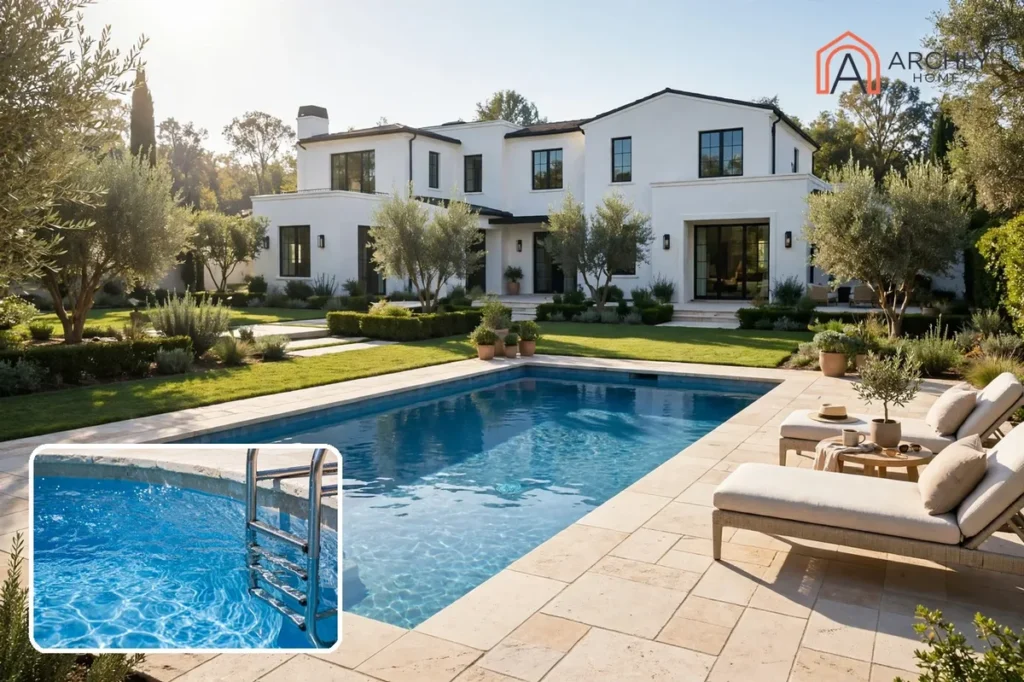
An inground pool typically costs $35,000 to $120,000 installed, with the national average sitting near $66,000. Most homeowners pay between about $44,500 and $87,000 for the pool itself, according to Angi’s 2026 cost guide, which is based on more than 1,400 verified projects. But that is only the pool. The deck, fence, electrical work, permits, and yard repair that turn a hole in the ground into a finished backyard commonly add another $25,000 to $30,000 — and that gap between the first quote and the final bill is where most pool budgets go wrong.
Every figure in this guide is an approximate planning range drawn from published national cost guides, not a quote. Your real price depends on your pool type, size, soil, access, region, and the features you pick. The only number that counts in the end is a written quote for your yard.
Inground Pool Cost By Type
Three construction types cover nearly every inground pool, and the choice sets your budget more than any other single decision. The ranges below are installed prices for a standard family-size pool, reconciled across the major published cost guides.
| Pool Type | Typical Installed Cost | Build Time | Yearly Upkeep | Best For |
|---|---|---|---|---|
| Vinyl Liner | $35,000 to $65,000 | 4 to 8 weeks | $1,100 to $1,700 | Lowest upfront cost, custom shapes |
| Fiberglass | $45,000 to $100,000 | 3 to 6 weeks | $500 to $1,500 | Fast install, lowest maintenance |
| Concrete / Gunite | $60,000 to $120,000+ | 8 to 16 weeks | $2,700 to $4,000 | Any shape, longest life, most features |
Vinyl Liner Pools
Vinyl is the cheapest way into an inground pool. A steel or polymer frame is assembled on site, and a custom vinyl liner is fitted inside. The shape can be customised within the kit’s range, and the smooth surface is comfortable underfoot. The trade-off is the liner itself: it is a wear part. Liners typically need replacing every 5 to 10 years, at roughly $3,000 to $7,500 a time depending on size, and they can puncture. Over 10 to 20 years, those replacements narrow the gap with fiberglass considerably — something the cheapest quote never shows.

Fiberglass Pools
A fiberglass pool arrives as a single factory-made shell, is lowered into the excavated hole by crane, and is usually swim-ready within a few weeks. The smooth gelcoat surface resists algae, needs fewer chemicals, and asks the least of you year to year — which is why fiberglass carries the lowest annual maintenance of the three types. The limits are shape and size: you pick from the manufacturer’s moulds, and road transport caps the shell at roughly 16 feet wide. If your dream pool is a freeform lagoon with a beach entry, fiberglass probably cannot build it.

Concrete / Gunite Pools
Concrete — sprayed as gunite or shotcrete over steel reinforcement — is the most expensive and the most flexible option. Any size, any shape, any depth: beach entries, grottos, infinity edges, attached spas, and tanning ledges are all possible, and a well-built concrete pool can last 50 years or more. It also demands the most upkeep. The porous plaster surface encourages algae, needs brushing several times a week, uses more chemicals, and typically needs resurfacing every 10 to 15 years at roughly $8,000 to $15,000. The build is the slowest too, commonly three to six months from design to first swim once permits and curing time are counted.

The Shell Quote Is Not The Project Price
This is the single most useful distinction in pool budgeting. Builders price the pool. You end up paying for a finished backyard. A first quote usually covers excavation, the shell or liner, plumbing, a pump and filter, basic coping, and start-up. It often does not cover the things that make the pool usable and legal.
| Extra | Typical Cost | Need It? |
|---|---|---|
| Safety fence or barrier | $2,000 to $13,500 | Required by most codes and insurers |
| Electrical work | $2,000 to $10,000 | Required — pump, lights, bonding |
| Permits | $100 to $1,800 | Required |
| Deck or patio | $3,000 to $20,000 | Practically required |
| Yard restoration and grading | $5,000 to $20,000 | Usually, after trucks cross the lawn |
| Heater | $1,600 to $5,500 | Optional, common in cooler climates |
| Safety or automatic cover | $2,700 to $20,000 | Optional, cuts heat loss and debris |
| Landscaping and plantings | $5,000 to $12,000 | Optional |
Add up only the required and practically required rows at their low ends and you are already past $12,000. At midrange choices, a fence, wiring, permits, a modest deck, and lawn repair together land near $25,000 to $30,000 — which is why a “$40,000 pool” so often becomes a $70,000 project. One published worked example prices a standard 16-by-32-foot pool as a finished yard, with no frills, at roughly $68,000 for vinyl, $83,000 for fiberglass, and $98,000 for concrete. If you are planning the space around the pool too, see our pool deck ideas and our guide to how much a fence costs before you set the budget.

What Moves The Price Up Or Down
Pool type and size set the baseline. These seven factors decide whether you land at the low end or the high end of the range.
Size and depth. More water means more digging, more shell material, and bigger equipment. Published guides put inground pools at roughly $90 to $250 per square foot of pool surface, though that figure swings widely with what each guide counts. A standard 14-by-28-foot pool and a 20-by-40-foot pool of the same type can be tens of thousands of dollars apart.
Shape. Rectangles and squares are the cheapest to build because they use materials efficiently and need straightforward construction. Freeform, kidney, and Grecian shapes cost more — especially in concrete, where every curve is hand-built. Fiberglass buyers are limited to the moulds on offer.
Site conditions. A flat, accessible backyard with sandy soil is the cheapest scenario. Rocky ground, steep slopes, a high water table, buried debris, and tight access for excavators or a crane all add cost, and nobody can price excavation fully until the hole is open. A sloped yard may need retaining walls, which can rival the deck in cost. A good contract states exactly what happens if the crew hits rock — a per-hour or per-load rate with a cap — rather than an open-ended “unforeseen conditions” clause.
Region. Labour rates, permit fees, and the length of the building season vary across the country. Published state figures put a typical project at roughly $34,000 to $55,000 in Alabama versus $52,000 to $79,000 in Vermont, and high-cost markets in California and the Northeast can run higher still. Treat every national figure as a starting point and get local bids.
Features. Tile, coping stone, interior finish, lighting, water features, automation, and heating each move the total by thousands. A heater alone typically adds $1,600 to $5,500 installed; a waterfall can add $4,000 to $20,000; an attached spa often adds $15,000 to $20,000. Features are far cheaper to build in during construction than to retrofit later.
Access. If an excavator, a concrete truck, or a fiberglass shell on a crane cannot reach your yard easily, labour and equipment charges rise. Narrow side yards, fences that must come down, and overhead wires all count.
Timing. Builders are busiest in spring, when everyone wants to swim by summer. Signing in late autumn or winter can mean better scheduling and sometimes off-season pricing, though digging may wait for the ground to thaw in cold climates.
Ongoing Costs: What A Pool Costs Every Year
The purchase price is only the beginning. A pool is a year-round commitment, and the yearly bill depends heavily on the pool type and whether you hire service or do the work yourself.
- Routine upkeep: roughly $1,000 to $1,800 a year for chemicals, electricity, water top-ups, and seasonal opening and closing if you maintain it yourself; $1,200 to $5,000 a year with weekly professional service.
- Chemicals: roughly $400 a year for a vinyl chlorine pool, more for concrete, less for fiberglass and saltwater systems — though salt cells need replacing every few years.
- Electricity: the pump is often the second-largest energy user in a home. A variable-speed pump costs more up front but uses far less power than an old single-speed model.
- Scheduled repairs: a vinyl liner every 5 to 10 years ($3,000 to $7,500), concrete resurfacing every 10 to 15 years ($8,000 to $15,000), fiberglass gelcoat refinishing usually after 20-plus years.
- Insurance and tax: most insurers raise the premium and require a code-compliant fence with a locking gate; many owners add an umbrella policy. An inground pool is a permanent improvement, so the assessed value of the home — and the property tax — can rise.
Over ten years, published estimates put total upkeep at roughly $11,000 to $17,000 for vinyl, $5,000 to $15,000 for fiberglass, and $27,000 to $40,000 for concrete. That is the real reason the cheapest pool to build is not always the cheapest pool to own.

How To Budget For An Inground Pool
A pool is one of the largest cheques a homeowner writes. A short, honest process keeps it under control.
Start with the finished yard, not the shell. Price the pool, then add the fence, deck, electrical work, permits, and yard repair before you decide what you can afford. A simple rule of thumb from cost guides: add 20 to 40 percent to the shell-and-equipment price for decking, fencing, electrical, and landscaping.
Get three written quotes for the same scope. Same pool type, same size, same depth, same equipment models, same inclusions. Compare them line by line — the lowest total is often the bid that leaves the most out. Every quote should name the excavation terms, soil haul-off, equipment makes and models, electrical and bonding work, decking material and area, fencing, permits, payment schedule, and warranties.
Tie payments to milestones. Permit approval, excavation, shell or steel, equipment, and a final holdback after the walkthrough. Treat a request for more than half the price before construction starts as a red flag, and ask for a lien waiver with every progress payment.
Check the builder, not just the price. Verify the licence and insurance with your state or local licensing authority, and ask your home insurer what the pool will add to your premium before you sign — not after the hole is dug.
Keep a cushion. Rock, soil, and access surprises show up after the contract is signed. A contingency of 10 to 20 percent on top of the finished-yard budget is realistic, not pessimistic.
Finance the whole project. If you borrow, include the fence, deck, electrical, and yard repair in the loan — not just the pool. Home equity loans and lines of credit usually carry lower rates than unsecured pool loans, but compare the total interest over the full term, not just the monthly payment.
Does An Inground Pool Add Value To Your Home?
Sometimes, and rarely the full cost. Published estimates commonly put the bump at roughly 5 to 8 percent of home value — about $20,000 to $32,000 on a $400,000 home — higher in hot Sun Belt markets where pools are expected, and near zero where the swim season is short. Most owners do not recover the full project cost at sale, and some buyers see a pool as a maintenance burden rather than a feature. If resale value is your main reason for building, talk to a local estate agent or appraiser first. If you are weighing a pool as part of a bigger backyard plan, our house plans with a pool and backyard landscaping ideas show how the pool fits into the whole property. For an independent second view on build costs, Bob Vila’s guide to how much it costs to build a pool covers the same ranges from another angle.
Frequently Asked Questions
How Much Does A Small Inground Pool Cost?
A small plunge or cocktail pool typically runs about $10,000 to $40,000, averaging near $28,000 in published guides. The pool itself is cheaper, but fencing, electrical work, and permits barely shrink, so the per-square-foot price is higher than for a full-size pool.
What Is The Cheapest Inground Pool To Build?
A vinyl liner pool, usually starting around $35,000 installed. It is the cheapest up front, but budget for a liner replacement every 5 to 10 years, which narrows the long-term gap with fiberglass.
How Long Does It Take To Build An Inground Pool?
Fiberglass is fastest at roughly 3 to 6 weeks of construction; vinyl liner pools take about 4 to 8 weeks; concrete pools take 8 to 16 weeks of active building, and commonly 3 to 6 months from design to first swim once permits and curing are counted. Design and permitting alone can take 4 to 8 weeks before digging starts.
Do I Need A Permit For An Inground Pool?
Almost always. Most areas require building and electrical permits, and many require a compliant safety barrier before the final inspection. Permit fees vary widely by jurisdiction, roughly $100 to $1,800 in published guides. Check your local building department before you budget.
How Much Does It Cost To Maintain An Inground Pool Per Year?
Roughly $1,200 to $5,000 a year depending on pool type and whether you hire weekly service. DIY maintenance on a vinyl pool runs about $1,000 to $1,800 a year for chemicals, power, water, and seasonal opening and closing; professional service on a concrete pool with heating can reach the top of the range.
An inground pool is a wonderful addition to a home — and a serious budget decision. Price the finished yard, not just the shell, compare three written quotes for the same scope, and go in knowing the yearly costs as well as the build cost. That is how a dream pool stays a dream instead of becoming a surprise.