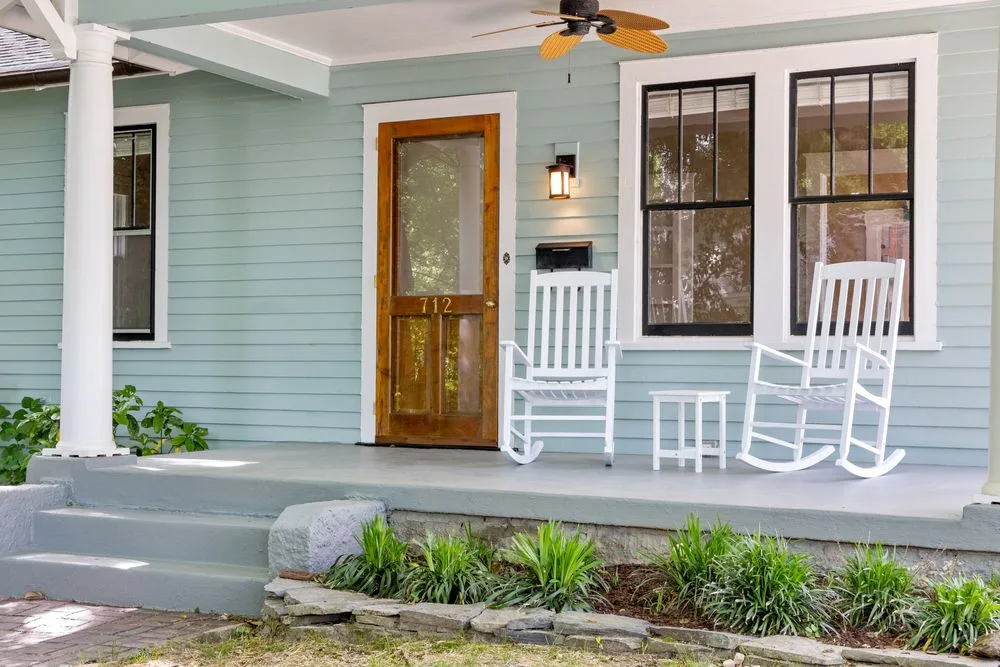
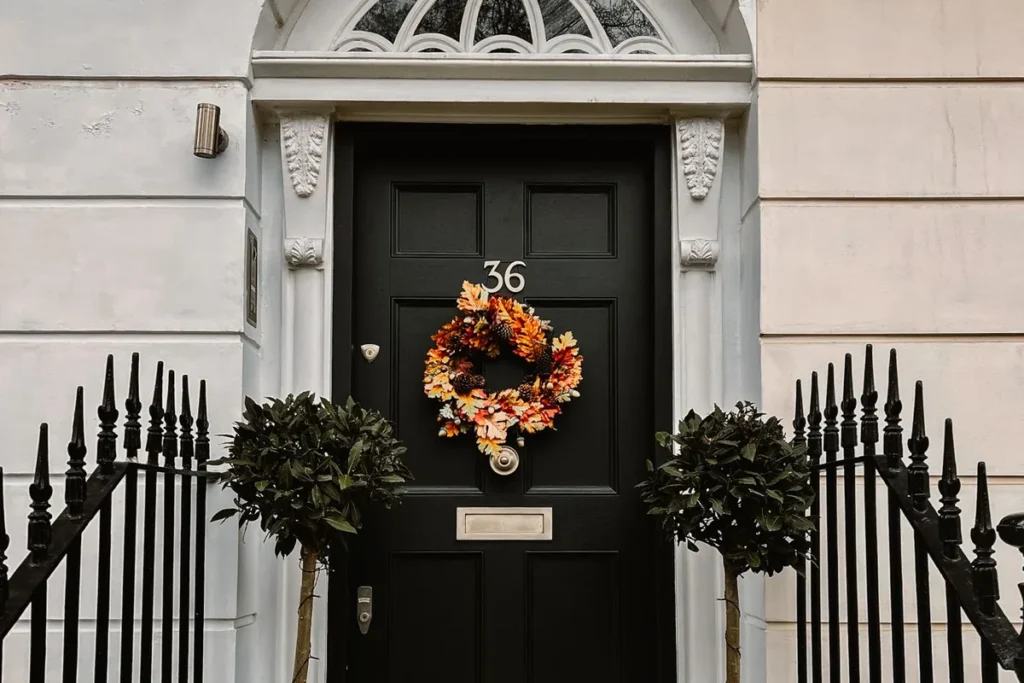
Your front door does more talking than any other part of your house. Before anyone steps inside, before they notice your paint color or your landscaping, they’ve already sized up the entryway — the wreath, the mat, the pots flanking the door. Front door decor ideas are among the cheapest, fastest upgrades in home improvement: most of what follows takes an afternoon, rearranges next season, and reinvents itself when your taste changes.
Treat the door like a small room with a job: welcome guests, signal your style, and look intentional from the curb. This guide covers wreaths, planters, lighting, seasonal swaps, and how to decorate a front door when the porch is barely wider than the mat.
Quick Answer
- The five core elements of front entry door decor ideas that always work: a properly sized wreath, flanking planters, a layered doormat, good lighting, and updated hardware.
- Scale everything to the door. On a standard 36-inch door, the wreath should sit at eye level, planters should reach roughly a quarter of the door’s height, and the mat should span the full width of the opening.
- Change only the accents each season. Keep a neutral base — door, planters, hardware — and swap the wreath, the mat, and one planter insert. That’s most of the seasonal change with almost no effort.
- Match decor weight to door color. Dark doors (black, navy) pair with bold contrast like brass and greenery; bright doors (red, yellow) need simpler, quieter surroundings.
What Are The Essential Elements Of Great Front Door Decorating Ideas?
Every well-dressed front door is built from the same handful of ingredients. Get these five right and the rest is just seasoning.
1. A wreath sized to the door. A wreath that’s too small looks apologetic; one that’s too big swallows the door. For a standard single door, aim for roughly 24 to 26 inches across, hung with its center at about eye level. Double doors call for two matching wreaths or one oversized piece around 30 inches. Use an over-the-door hanger or a magnetic hook instead of hammering a nail.
2. Flanking planters. Two matching pots — one on each side — create instant symmetry, which reads as polished from the street. Keep them substantial, roughly knee-height at a minimum, or they’ll look dwarfed next to the door. If one side has no room, a single tall planter beside a smaller companion pot at a different height still reads beautifully.
3. A layered doormat. The layered look — a larger outdoor rug underneath a smaller coir mat — has stuck around because it genuinely works. The base rug adds pattern while the coir top scrapes the shoes. Make sure it covers the full width of the opening; a mat narrower than the doorway looks like a postage stamp.
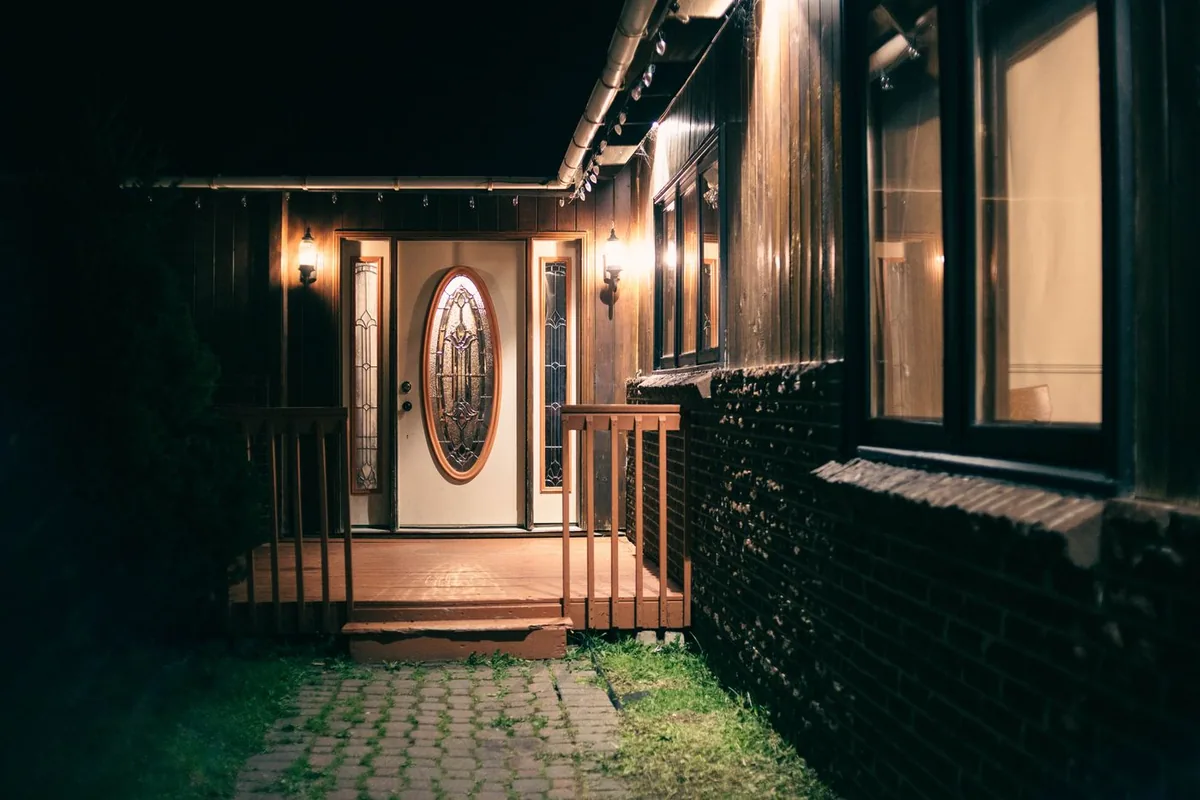
4. Thoughtful lighting. Nothing ruins nice front door decor faster than a dead bulb or a dated fixture. A warm-lit sconce beside the door makes the whole entry look intentional after dark. If you can’t replace the fixture, clean the glass, swap in a warm-white LED, and add battery lanterns or solar path lights along the walk.
5. Hardware with some intention. The handle, hinges, knocker, and house numbers are the door’s jewelry. Mismatched finishes — a chrome knob, a brass knocker, a black deadbolt — quietly cheapen everything around them. You don’t need expensive hardware; you need matching finishes, like matte black, aged bronze, or brass.
Once the base is set, decorate around it instead of starting from scratch every season. These same five elements show up in most front porch ideas, because a porch is really just a front door with extra square footage — and the wraparound verandas on classic farmhouse house plans are proof of how far a few good elements can go.
How To Decorate A Front Door For Each Season?
Seasonal swaps are where front door decorating gets fun — and where most people overspend. The system that works: keep a permanent base (planters, rug, lighting, hardware) and rotate only the accents — the wreath, the mat topper, and the planter inserts.
Spring is about freshness: a wreath with budding branches or tulip accents, planters of pansies or petunias where your climate allows, and a cheerful patterned mat. Summer leans relaxed — swap in a lightweight grapevine wreath, trailing ivy or heat-tolerant blooms in the planters, and a striped or coastal rug. Fall wants texture: a wreath of dried wheat or fall leaves, planters stuffed with mums, and pumpkins or gourds stacked on the steps in odd numbers. Winter goes evergreen: a pine or cedar wreath, red berries or pinecones tucked into the planters, and a warm, simple mat that can handle wet boots.
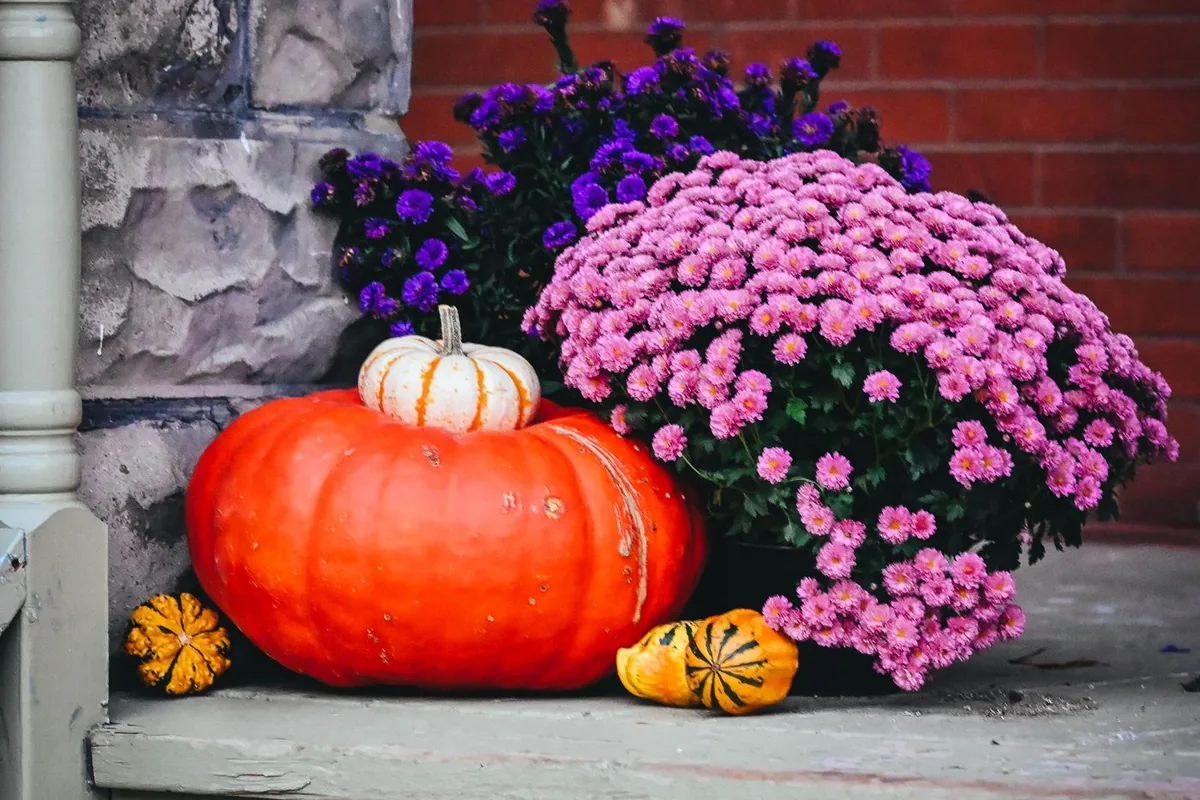
Here’s a quick reference for what to swap each season:
| Season | Wreath | Planter Filler | Ground Accents |
|---|---|---|---|
| Spring | Budding branches, tulip or blossom accents | Pansies, petunias, snapdragons | Patterned rug, welcome mat refresh |
| Summer | Lightweight grapevine or eucalyptus | Trailing ivy, heat-tolerant annuals | Striped or coastal rug |
| Fall | Dried wheat, fall leaves, berries | Mums, ornamental kale, grasses | Pumpkins and gourds in odd numbers |
| Winter | Cedar, pine, or boxwood with berries | Evergreen cuttings, pinecones | Warm-toned mat, lanterns |
One more rule: take things down on time. A rotting pumpkin in December or a Christmas wreath in March undoes all your effort. Change the door when you change the clocks and it’ll always look deliberate.
How Do You Style Decor Around Different Door Colors?
The door itself is your biggest decor element — the color you choose (or inherit) should steer everything around it.
Black and dark navy doors are dramatic and forgiving. Greenery pops against them, and they look sharp with brass or gold hardware. Keep the mat simple — natural coir, maybe over a patterned base rug — and let the wreath carry the color.
Red and bold doors are the star already — everything around them should calm down, not compete. Neutral planters (black, white, or natural clay), simple greenery wreaths, and a plain doormat work best. Adding more red — red mats, red pots, red flowers — usually reads as too much.
Yellow or teal doors suit a playful, coastal entry. Keep the decor light and simple: white or natural-fiber planters, airy wreaths, pale mats. These doors already do the talking.
White and light gray doors need contrast, or decor washes out: darker planters, a lush full wreath, and a mat with a strong pattern. Matte black hardware and house numbers anchor the look.
Wood-stain doors bring their own warmth and pair best with black or bronze accents, simple greenery, and natural materials like clay pots. Skip anything too fussy — the door’s grain is already the texture.
If you’re choosing a new color altogether, browsing a gallery of front door and shutter color combinations from HGTV is a solid way to see how door color plays against shutters, siding, and brick before you commit to a can of paint.
What If Your Porch Is Tiny — Or Non-Existent?
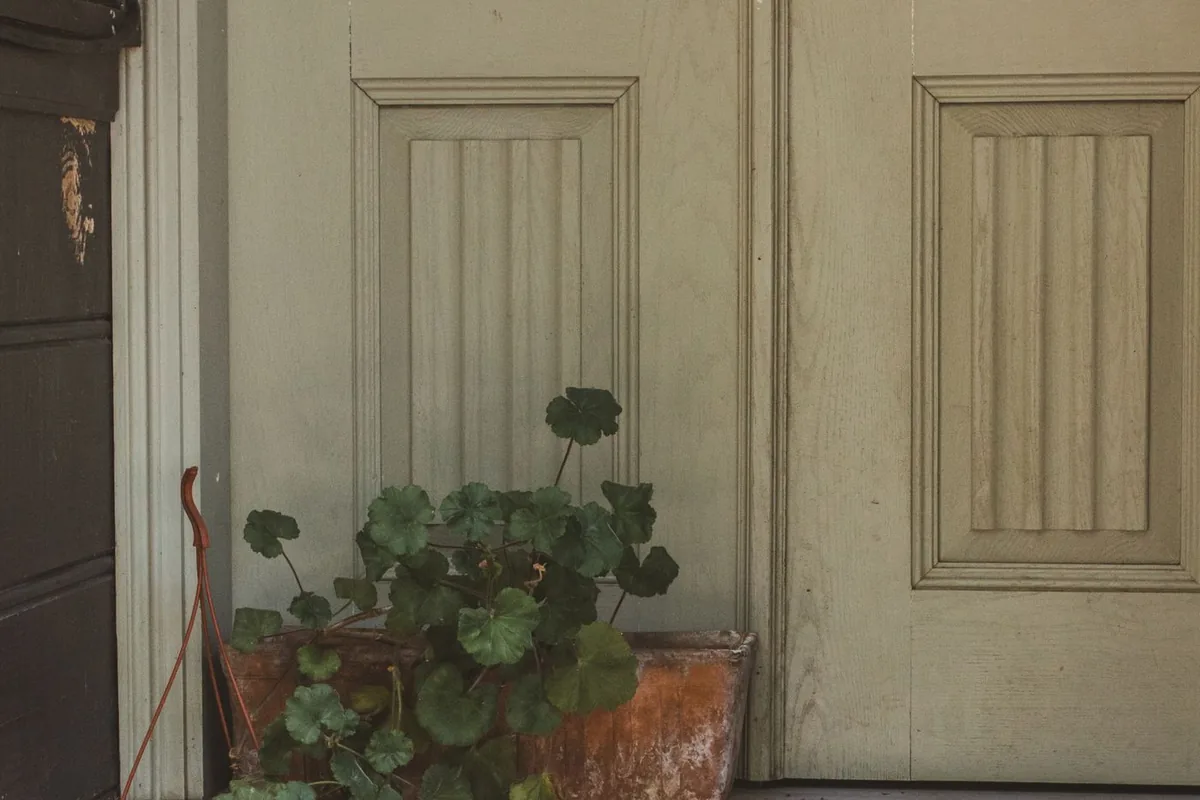
Plenty of homes have nothing more than a slab of concrete — especially ranch-style homes, where the entry is often a compact stoop. A small entry just means decorating vertically and asymmetrically instead of symmetrically.
- One tall planter instead of two. A single urn-height pot on the handle side of the door, with a smaller pot beside it, fills the visual space without blocking the walkway.
- Hang the greenery. Wall-mounted planters, hanging baskets, or a lantern beside the door add interest without touching the floor.
- Go slim on the mat. A runner-style mat works when a standard square mat crowds the slab. Layering is usually too much at this scale — one good mat is enough.
- Use the wall. House numbers, a small sconce, and even a slim wreath on a narrow door carry the design when there’s no floor to decorate.
The rule of thumb: leave the walking path clear. Decor should frame the entry, never force guests to shuffle sideways past it.
What Are The Best Budget-Friendly Front Door Decor Ideas?
You don’t need a big budget to make a door look expensive. Some of the best front door decor ideas cost almost nothing — they just take a little attention.
- Repaint the door. A quart of exterior paint transforms the whole entry. Dark, saturated colors like deep green, navy, and black read premium on almost any house.
- Polish or spray the hardware. Brasso on an old brass knocker, or a can of matte-black spray paint on tired hinges and numbers, can look like a full hardware upgrade.
- Make your own wreath. A grapevine base plus foraged branches, dried flowers, or grocery-store greenery costs a fraction of a store-bought wreath and looks more personal.
- Refresh the pots. Clay pots spray-painted a uniform color — charcoal, cream, or matte black — look designer-grade lined up in a row.
- Clean everything. Power-wash the slab, scrub the threshold, wipe the glass, and oil the hinges. A spotless basic entry beats a decorated dirty one every time.
What Mistakes Make A Front Door Look Cheap?
Sometimes the biggest win isn’t adding something — it’s removing something.
Clutter. Ten small decorations make an entry look messy; three well-scaled ones make it look designed. If you have to think about whether something works, it probably doesn’t.
Tired doormats. A curled, faded, stained mat drags everything down. Mats are cheap — replace yours when it looks worn, not when it disintegrates.
Faded or plastic plants. One sun-bleached artificial plant is worse than no plant. If real ones keep dying, switch to sturdy evergreens like boxwood or use quality dried arrangements instead.
Seasonal leftovers. The Easter bunny in June. The harvest wreath in January. Nothing dates an entry faster than decor that’s clearly past its season.
Neglected paint and peeling trim. No wreath can cover peeling paint or flaking trim. If the door itself needs attention, that comes before any decoration.
Wrong-scale everything. A tiny mat, a miniature wreath, and pots you could fit in a shoebox make even a nice door look underdressed. When in doubt, go one size up.
Frequently Asked Questions
How Do I Decorate My Front Door On A Tight Budget?
Start with a fresh coat of paint on the door — a quart of exterior paint is one of the highest-impact, lowest-cost upgrades you can make. Then layer in a clean doormat, one good wreath, and a single healthy planter. Keep a neutral base and rotate just the wreath and mat for the seasons instead of redecorating from scratch each time.
What Size Wreath Should I Get For A Standard Front Door?
For a standard 36-inch door, a wreath around 24 to 26 inches across hits the sweet spot — visible from the street without crowding the door. Hang the center roughly at eye level. For double doors, use two matching wreaths or one large wreath around 30 inches.
What Plants Do Best In Front Door Planters?
Reliable choices include boxwood and other evergreens for year-round structure, ferns for shaded entries, and heat-tolerant annuals like lantana or geraniums for sunny spots. In fall, mums and ornamental kale are the classics; in winter, evergreen cuttings and pinecones need no watering at all.
How Often Should I Update My Front Door Decor?
A good rhythm is four light updates a year — one per season — changing only the wreath, the top mat, and the planter contents. Twice a year (spring and fall) works too. The key habit is removing each season’s decor on time; a timely, simple entry always beats an elaborate stale one.
Should Both Sides Of My Front Door Match?
Symmetry photographs well and looks polished, but it’s not a rule. Matching planters on both sides is the classic look and works on almost any entry. If your entry is narrow or one side opens to a garage wall, a single tall planter paired with a smaller pot — asymmetric but balanced — looks just as intentional and often more interesting.
Conclusion
A beautiful front door isn’t about buying the most decorations — it’s about choosing a few good ones and giving them room to work. Set the base once: a door color you love, matching hardware, real lighting, and planters with weight. Then seasonal changes become the fun part — a wreath swap, a fresh mat, a pot of mums. Whether you’re styling front porch ideas for a deep veranda or dressing a bare stoop, the principles hold: scale to the door, swap accents with the seasons, and edit out anything past its prime. Your entry is the handshake of your home. Make it a good one.