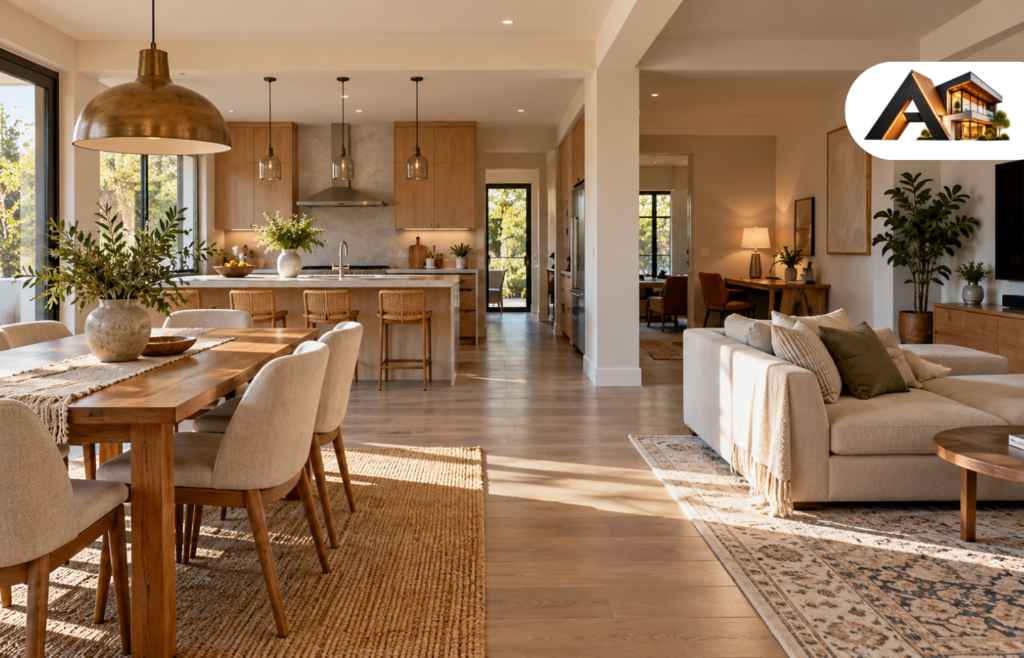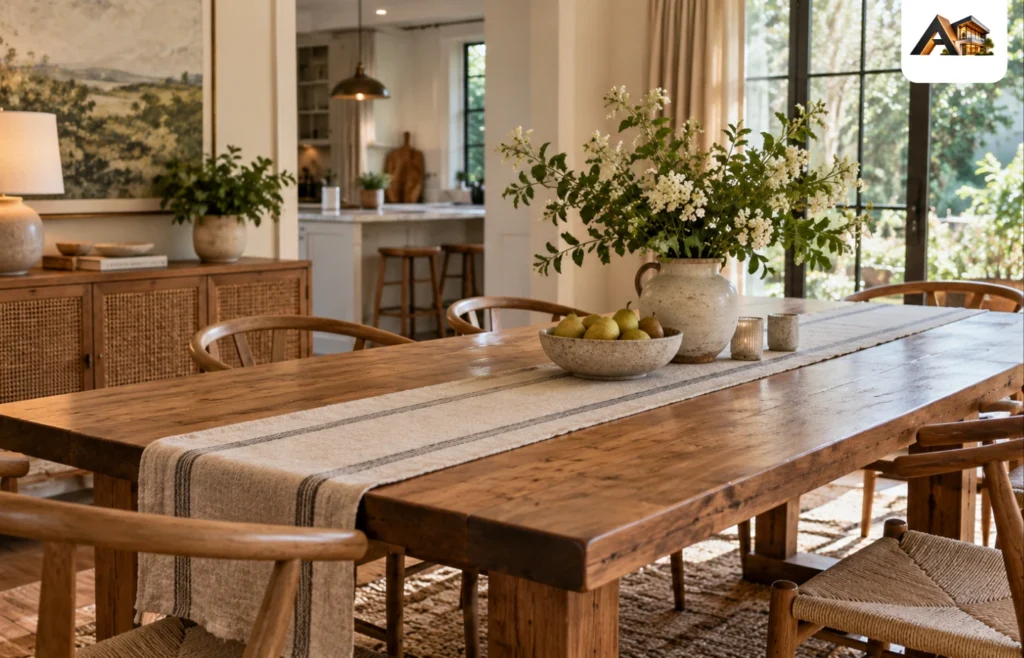
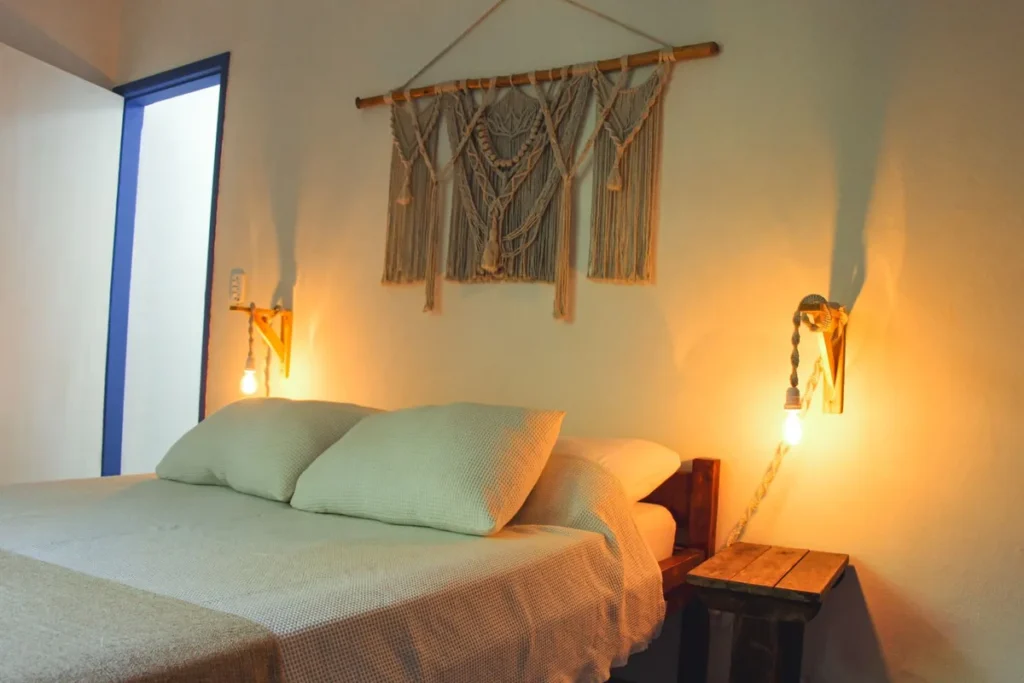
A boho bedroom rarely starts with a shopping list. It starts with a feeling: a room that looks soft at the edges, warm in the light, and a little bit gathered rather than arranged. The bed invites a longer lie-in. The textures ask to be touched. Nothing matches perfectly, yet nothing feels accidental either. That balance is the whole trick.
This guide stays on the style itself — the layering, the materials, the colour, the plants, and the light — rather than on one single element such as wall art or window treatments. Change one layer at a time. A bedroom that grows slowly tends to look more convincing than one bought in a single afternoon.
What Makes A Bedroom Feel Boho
Boho is less a set of rules and more a way of combining things. A matched bedroom set, identical lamps, and one repeating print in a single colour will fight the look, because boho depends on variety. At the same time, variety without any connection turns into clutter. The connection usually comes from repetition: the same warm wood tone appearing in a headboard and a picture frame, or the same terracotta shade turning up in a cushion and a plant pot.
Another defining quality is softness. Hard, glossy, and sharply tailored surfaces have their place in other styles, but a boho bedroom leans toward matte finishes, washed linen, chunky knits, raw wood, and clay. Edges are rounded or slightly uneven. Fabrics drape rather than sit stiffly. Even the furniture tends to sit a little lower and look a little more relaxed, which suits a room meant for rest.
Start With A Calm Base And Build Warmth On Top
The fastest way to make boho feel chaotic is to start with a busy base and then add more pattern on top. A calmer starting point gives every later layer room to breathe. Warm white, cream, soft sand, and pale plaster tones all work well on walls, because they reflect light and let textiles and wood do the talking. If plain white feels too stark, a warm off-white or a very soft clay wash on one wall can add depth without closing the room in.
Floors deserve the same thinking. Bare wood, a large natural rug, or a flatweave in a muted tone will ground the bed and soften footsteps. A rug that stops well short of the bed on every side tends to look like an afterthought, so size it to extend beyond the bed’s edges where the floor allows. Layering a smaller patterned rug over a larger plain jute or wool rug can add interest, but only if the two share at least one colour.
Once the base is calm, warmth can be added in small, deliberate moves. A wooden headboard, a woven laundry basket, a clay vase on the dresser, and a throw in a sun-warmed tone will already shift the mood. Step back after each addition and look at the room from the doorway. If something jumps out as too bright, too shiny, or too busy, that piece is usually the one to soften or move.
Layered Bedding That Looks Collected, Not Cluttered
Bedding carries more of a boho bedroom than any other single choice, because the bed takes up the most visual space. The layered look works best when it is built in stages, starting with the simplest layer and stopping before the bed becomes hard to get into. Crisp or washed cotton sheets in a neutral tone make a forgiving foundation. A linen or cotton duvet in cream, oat, or soft white keeps the bed light, while a folded coverlet or quilt across the lower third adds weight and pattern without hiding the whole bed.
Pattern mixing follows a simple discipline that keeps the bed interesting without turning it noisy. Choose patterns that share a colour, vary their scale, and let plain fabrics rest the eye between them. A large-scale block print, a small geometric weave, and a solid textured throw can sit happily together when terracotta or sage threads through all three. Texture does much of the work here: linen against cotton, a knitted throw against a smooth duvet, and a fringed edge against a plain hem all add depth even when the colours stay quiet.
Natural Materials That Carry The Whole Look
If bedding sets the mood, natural materials give a boho bedroom its backbone. Rattan, cane, bamboo, jute, seagrass, solid wood, linen, cotton, wool, and clay all bring a slightly imperfect, tactile quality that manufactured gloss cannot copy. A rattan headboard, a cane-fronted nightstand, a jute rug, and a woven pendant light can carry the style even when the rest of the room stays simple. The trick is to repeat each material at least once, so it reads as a choice rather than a stray object.
Wood tone deserves particular attention. Mixing every wood finish in the house — pale ash, dark walnut, reddish teak, painted white — in one small bedroom can make the room feel restless. Picking one dominant wood tone and letting the others appear only in small accents keeps things settled. Warm, mid-toned woods tend to sit most comfortably with terracotta, cream, and sage, while paler woods suit a brighter, more coastal version of boho. For a closer look at rattan, bamboo, jute, and solid wood in real bedrooms, see IKEA’s guide to sustainable bedroom materials.
Colour Without Chaos
Boho colour works best as a small, warm palette with one or two deeper notes. A base of cream, sand, and soft white keeps the room bright. Warm earth tones — terracotta, clay, rust, ochre, and muted olive — add the sun-baked character people associate with the style. Deeper accents such as forest green, dusty teal, or a muted burgundy can appear in cushions, art, or a single throw, but they work hardest when they stay in the minority.
The table below shows one way to divide the palette so no single colour takes over.
| Palette Role | Colours To Try | Where It Belongs |
|---|---|---|
| Base | Warm white, cream, sand | Walls, main bedding, large rug |
| Warmth | Terracotta, clay, ochre | Cushions, throws, pottery |
| Calm | Sage, olive, dusty teal | Plants, one accent textile, art |
| Depth | Walnut, charcoal, muted burgundy | Wood furniture, one dark cushion, frames |
A useful habit is to carry the accent colour through the room in at least three places, but in different sizes: a cushion, a plant pot, and a print, for example. That repetition ties the room together without painting every surface the same shade. Darker versions of boho exist too — deep green or warm charcoal walls with cream bedding and brass or rattan details — and they can look striking, provided the lighting stays warm and the bedding stays light enough to keep the bed as the bright point of the room.
Plants That Make A Boho Bedroom Feel Alive
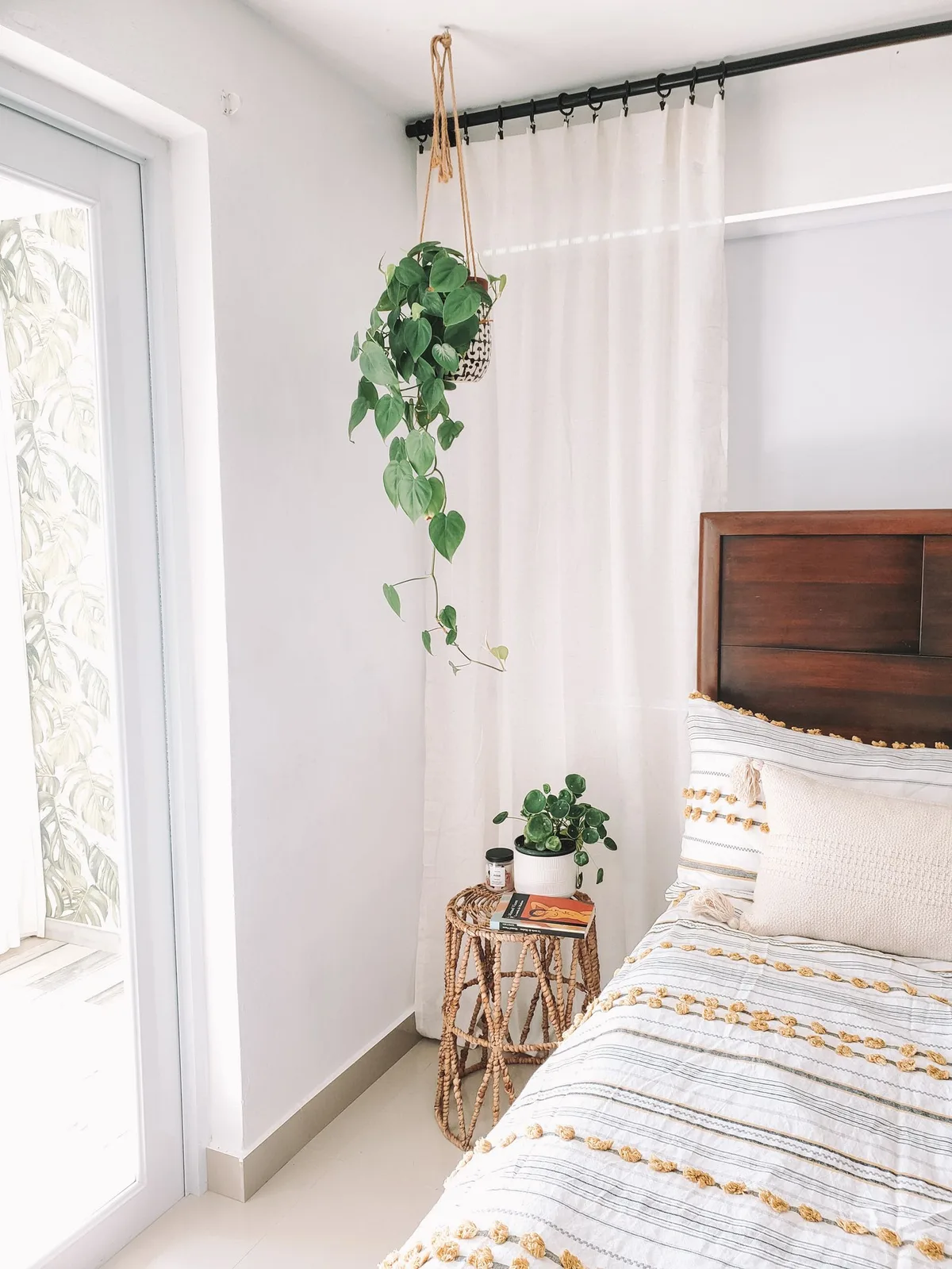
Few things change a boho bedroom as quickly as plants. They soften hard corners, break up flat walls, and add a living green that no textile can quite match. The most convincing plant displays use height as well as quantity: a tall floor plant in one corner, a trailing plant on a shelf or hanging holder, and a small potted plant on the nightstand or dresser. That spread of heights draws the eye upward and makes the greenery feel arranged rather than lined up along a windowsill.
Light honesty matters more than plant enthusiasm. A bedroom with a bright window can support a wider range of plants than a room with a small window, and it helps to match the plant to the spot rather than hoping a sun-loving plant will adapt to shade. Trailing pothos, snake plants, and ZZ plants are commonly recommended for bedrooms because they tolerate a range of indoor light and occasional missed watering, but every plant still needs its own check: how much light the spot actually gets, whether the pot drains, and whether the soil has dried out before watering again.
Pots and holders are part of the styling, not an afterthought. Terracotta, clay, woven baskets with a liner, and simple ceramic pots all suit boho better than glossy plastic, and keeping pot colours within the room’s palette stops the plant corner from looking like a garden centre display. Hanging planters in macramé or cotton cord add height without taking floor space, which is especially helpful in smaller rooms. A little editing helps: three healthy plants at different heights usually look better than ten crowded ones competing for light and attention.
Lighting For Soft Evenings And Slow Mornings
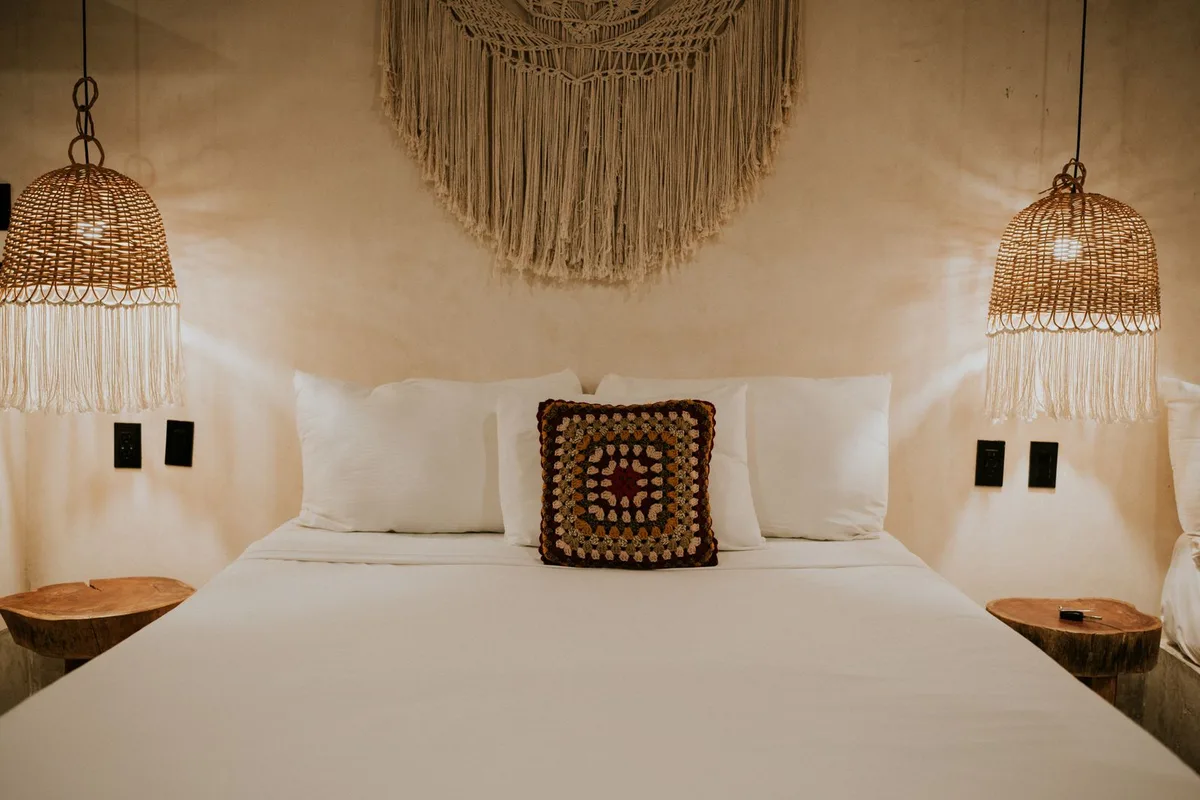
Boho lighting is layered, warm, and low rather than bright and central. A single harsh ceiling light flattens every texture in the room, which is the opposite of what layered textiles and woven materials need. A better setup uses three kinds of light: a main pendant or ceiling fixture for general brightness, bedside lamps or wall lights for reading, and a small warm accent such as fairy lights or a candle-style lamp for evenings. Each layer can be switched separately, so the room can shift from practical morning light to a softer evening glow.
Woven, rattan, and cane shades suit this style particularly well, because they filter light into a warm pattern and add texture even when switched off. A rattan pendant over the bed or in a corner, paired with simple linen-shaded bedside lamps, covers most bedrooms without needing anything ornate. Warm-toned bulbs make the biggest single difference: cool white light can make terracotta look flat and wood look grey, while a warm glow brings out the honey tones in both.
Window light deserves attention during the day as well. Sheer linen or cotton panels soften strong sunlight and give the room a gentle, filtered quality, while a heavier outer layer can be drawn for privacy or darkness at night. Keeping the window area fairly clear lets daylight do its work.
Safety still comes first with candles and fairy lights. Real candles belong on stable, heat-safe surfaces away from bedding, curtains, and trailing plants, and they should never be left burning in an empty room. Battery-operated candles and well-made fairy lights give a similar glow without the same risk.
Furniture And Storage That Look Found, Not Bought As A Set
Mismatched furniture is one of boho’s pleasures, provided the pieces share a feeling rather than a catalogue page. A wooden bed frame, one rattan nightstand and one painted wooden one, a small vintage chair, and a woven bench at the foot of the bed can look entirely at home together when their wood tones and scale are close. The shared thread might be warm wood, a similar height, or a simple, unfussy shape. Without any shared thread, the room starts to look like a furniture sale rather than a collection.
Storage is where boho bedrooms either stay calm or slide into mess. Woven baskets, seagrass boxes, and lidded trunks hide everyday clutter — spare bedding, chargers, books, and off-season clothes — while adding texture at the same time. A large basket beside the bed for throws, a smaller one on the dresser for odds and ends, and a trunk or bench with storage at the foot of the bed will cover most bedrooms.
A reading corner, even a small one, gives a boho bedroom a second purpose beyond sleep. A comfortable chair, a small side table, a lamp, and a basket for books turn an unused corner into a place someone actually sits. If space is tight, a floor cushion and a low stool can do similar work without blocking the room’s flow.
Boho Bedroom Decor Ideas For Small Rooms
Small bedrooms can carry boho beautifully, as long as scale is respected. Oversized furniture, too many small objects, and heavy layering all shrink a small room faster than its actual dimensions would suggest. A lower bed frame, a single statement textile rather than five competing ones, and one large plant instead of a crowd of small pots will keep the room feeling open. Mirrors help here, not as decoration alone but as a practical way to bounce light and give the eye more depth, especially when placed opposite or beside a window.
Rental-friendly changes deserve a special mention, because many boho lovers are renters. Removable hooks hold hanging planters and macramé without drilling. A large textile hung from a tension rod or removable hooks can act as a soft headboard. Layered rugs, bedding, baskets, and lamps change the room completely without touching the walls or floors, and all of it can move to the next home.
In a small room, the editing rule tightens: every object should earn its place by being useful, beautiful, or both. A basket that holds blankets earns its place. A third decorative tray on the same dresser probably does not. Stepping back and removing one thing often improves a small boho bedroom more than adding anything new.
Mistakes That Make Boho Look Messy
Boho’s relaxed spirit makes it easy to excuse clutter as character, but there is a line, and most messy boho rooms cross it in the same few places:
- Buying a whole matching boho set in one order, so the room looks themed rather than collected.
- Mixing too many strong patterns with no shared colour to hold them together.
- Covering every surface, so no object has space to be noticed.
- Using only small decor pieces in a large room, which reads as scattered rather than styled.
- Choosing plants for looks alone, then placing them where they cannot get the light they need.
- Relying on one harsh ceiling light instead of layered, warm lighting.
- Adding colour everywhere at once, instead of letting one or two accents repeat calmly.
Most of these are easy to correct without starting over. Removing the weakest pattern, grouping small objects into one tray, swapping a cool bulb for a warm one, or moving a plant closer to the window can change the room’s feeling in an afternoon. The fix is usually subtraction, not another purchase.
Frequently Asked Questions
Do I Need To Repaint To Get A Boho Look?
No. Paint can help, especially a warm white or a soft clay tone, but textiles, wood, plants, and lighting do most of the work. A room with plain walls, layered bedding, a woven rug, and warm lamps will already read as boho. Repainting is worth considering only if the existing wall colour fights the palette, such as a cold grey that dulls terracotta and wood tones.
How Can I Keep A Boho Bedroom Calm Instead Of Busy?
Limit the palette to a warm base plus one or two accents, repeat one or two natural materials, and leave empty space on surfaces and walls. Choose fewer, larger pieces over many small ones, and let texture carry the interest where colour stays quiet. This restrained version is often called modern boho, and it suits people who like the warmth of the style without its maximalist side.
Can Boho And Minimalism Work In The Same Bedroom?
They can, when boho supplies the warmth and minimalism supplies the discipline. Keep furniture low and simple, bedding mostly plain with one textured throw, and decor limited to a plant, a basket, and one piece of woven art. The room will feel softer than a strict minimalist space and calmer than a fully layered boho one, which is exactly the balance many small bedrooms need.
A Room That Grows With You
A good boho bedroom does not demand perfection, and it does not stay frozen once it is decorated. A throw gets swapped when the seasons change. A plant outgrows its pot and moves to the floor. That slow accumulation, guided by a calm base, a warm palette, and a few repeated materials, is what gives the style its staying power.