
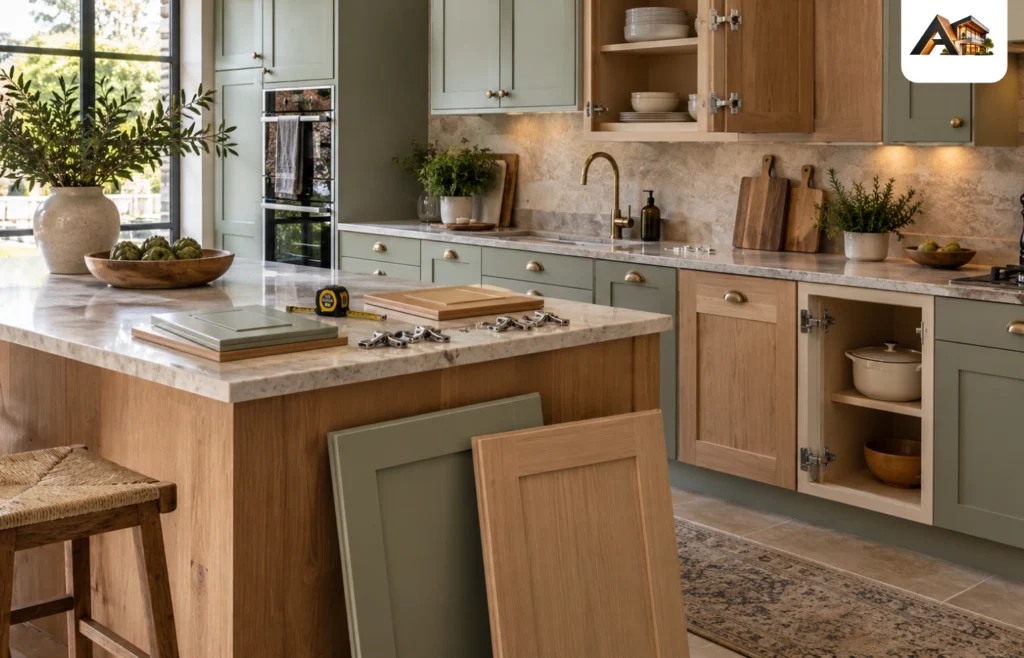
Replacing the doors on your kitchen units can refresh the room while keeping cabinets and worktops that still serve you well. The key is choosing fronts that fit the existing units, work with the hinges, and suit everyday cooking and cleaning.
Start with the condition of the cabinets, then check measurements and compatibility before choosing a colour. This guide explains how to compare replacement kitchen doors, avoid ordering mistakes, and plan the complete update.
Can You Replace Kitchen Doors Without Replacing the Units?
Yes—replacement doors are worth considering when the cabinet boxes, often called carcasses, are sound and the layout still works. However, new fronts will not fix swollen cabinet panels, weak hinge fixings, or storage that no longer meets your needs.
Open each cupboard and inspect the structure behind the door. Pay particular attention to the sink unit, exposed panel edges, and the areas where hinges attach. If screws repeatedly pull loose or the board has deteriorated, address that problem before ordering fronts.
Separate appearance problems from functional ones. An outdated colour is a good reason to consider replacement doors. An awkward kitchen layout deserves a wider review before you spend money on cosmetic changes.
Also check what remains visible when everything is closed. End panels, plinths, filler strips, and exposed cabinet edges may need attention alongside the doors.
Check Compatibility Before Choosing a Style
Kitchen unit doors are not universally interchangeable. Matching the width alone does not establish that a replacement will fit. Height, thickness, hinge positions, and the way the door sits against the cabinet all matter.
Even products from the same retailer may belong to different systems. IKEA, for example, confirms that METOD and the older FAKTUM kitchen systems have different dimensions. A familiar brand name is therefore not enough to establish compatibility.
If possible, identify the original manufacturer and range from receipts, labels, or installation paperwork. Otherwise, photograph the cabinets, hinges, and drawer fittings and send these alongside your measurements to a replacement-door supplier.
For a kitchen with unusual sizes, investigate made-to-measure fronts. Ask the supplier to confirm the drilling and hardware requirements as well as the finished dimensions.
Standard Cupboard Doors, Drawer Fronts, and Appliance Panels
These components may look similar from the outside, but their fixings can differ.
A cupboard door attaches to hinges. A drawer front connects to its drawer box or brackets. An integrated appliance panel must work with the appliance’s fitting system.
Treat each type separately on your order. For integrated fridges, freezers, and dishwashers, check the appliance model and installation instructions before specifying a front. Ask the fitter or supplier to confirm any required panel dimensions, weight limits, and operating clearances.
How to Measure for Replacement Kitchen Doors?
When an existing door fits correctly, measure that door rather than assuming its dimensions from the cabinet size.
Kitchen Warehouse gives an example of a 720 × 600 mm base unit using a 715 × 596 mm door. The difference allows operating clearance; it is an example, not a universal sizing rule.
Use this sequence:
- Label each position. Write descriptions such as “base cupboard left of sink” or “upper drawer beside oven.”
- Measure the existing front. Record height and width in millimetres, preferably across its flat back.
- Record thickness separately. Ask the supplier whether the proposed replacement works with your hinges and available clearances.
- Measure each different front. Include wall cupboards, tall doors, drawers, and appliance panels.
- Check the supplier’s ordering convention. Confirm whether the form asks for actual finished door dimensions or nominal cabinet sizes.
If you are ordering to match a correctly fitting door, do not subtract another allowance for gaps. If the old front is missing, warped, or poorly sized, have the supplier establish the required dimensions from the cabinet and its intended clearances.
Record Hinge Holes Carefully
For pre-drilled doors, suppliers commonly request the distance from the top edge to the centre of the upper hinge hole and from the bottom edge to the centre of the lower hole. Doors with additional hinges require those positions to be specified too. Follow the supplier’s diagram so there is no ambiguity about the reference edge.
Also confirm the required hole diameter, depth, and position relative to the side edge. A correct door size with incorrect drilling can still leave you with an unusable replacement.
Photograph the back of each unusual door with its label visible. This gives the supplier something clear to check against your measurement list.
Compare Door Construction, Not Just the Finish Name
“Matt,” “gloss,” and “wood effect” describe appearance. They do not fully explain what a door is made from.
Ask about both the core material and the surface finish. For example, an MDF door may be painted, vinyl-wrapped, or acrylic-faced. A wood veneer is a thin layer of real timber bonded to a supporting board. These are different constructions, even when their colours look similar.
| Door construction | Why consider it? | What to check before buying |
| Painted MDF | Smooth colour with a choice of profiles | Edge finish, care instructions, and touch-up options |
| Melamine-faced board | Decorative colours and wood effects | Edge quality and the specification of the supporting board |
| Vinyl- or foil-faced MDF | Wrapped finishes in plain colours or wood effects | Appliance-adjacent use, care requirements, and warranty terms |
| Timber or timber-framed | Natural character and visible grain | Whether the centre panel is timber or veneer |
| Wood veneer over board | Real wood surface on a supporting core | Grain direction and coordination across adjacent fronts |
| Acrylic-faced board | A sleek surface, including high-gloss options | Approved cleaning methods and the finish of exposed edges |
The construction descriptions above reflect the distinctions set out in DIY Kitchens’ material guide; the questions help you compare individual products.
Request a physical sample before committing. Examine the face, back, and edges, then ask how the supplier recommends cleaning it and dealing with accidental damage. Avoid treating a material name alone as a guarantee of durability.
Choose a Style That Works With the Kitchen You Are Keeping
Replacement fronts need to look right beside the existing worktop, floor, splashback, and appliances. A sample that looks appealing online may feel quite different against those fixed surfaces.
Common options include Shaker, slab, and integrated-pull designs. Retailer ranges distinguish these as separate styles, so compare their profiles as well as their colours.
Shaker doors have a framed appearance around a recessed centre. They can introduce detail to a plain kitchen, but look carefully at the proportions on narrow doors and small drawer fronts.
Slab doors have a flat face. Consider them when you want simple lines, particularly if the worktop or splashback already has a strong pattern.
Integrated-pull designs incorporate a grip into the front. Try the grip in person if possible, especially on heavier doors.
Before switching to a handleless arrangement, ask how it operates with your existing cabinets. Confirm whether the chosen design requires additional profiles, different hinges, or opening mechanisms.
Test Colour Beside Existing Surfaces
Hold the sample vertically against a cupboard and view it in daylight and under the kitchen lights. Compare it directly with the worktop and splashback.
If you are keeping cream cabinet edges, for example, check whether a bright white front makes the difference distracting. You may prefer a coordinating colour or decide to include matching panels in the update.
For a two-colour scheme, define the boundary clearly—such as a separate island or the lower cupboards—before ordering. Include the matching end panels in that decision.
Budget for the Whole Visible Kitchen
A price per door is only one part of the project. Request an itemised quote based on the same component list from each supplier.
Include:
- Cupboard doors, drawer fronts, and integrated appliance panels.
- Hinges, mounting plates, handles, and any opening mechanisms.
- End panels, plinths, filler pieces, and decorative trims.
- Measuring, drilling, delivery, fitting, and disposal where required.
- Applicable taxes and any charges for custom sizes.
Check whether pre-drilling is included and whether handles arrive separately. Ask about the ordering terms for bespoke components before approving the measurements.
A useful comparison is the cost of the completed update against the condition and usefulness of what you are keeping. If the project also needs several new cabinet boxes, drawer mechanisms, worktops, and layout changes, obtain a broader refurbishment quote before proceeding.
Decide Whether to Fit the Doors Yourself
A straightforward replacement may be manageable if the cabinets are sound, the fronts are correctly drilled, and the hardware is confirmed as compatible. Custom drilling, damaged fixing points, unusual corner arrangements, and appliance panels are stronger reasons to involve a kitchen fitter.
Before removing the old fronts, photograph the arrangement and label each component. Keep the original doors until the replacements have been checked.
Inspect the delivery before drilling handle holes or making alterations. Then trial-fit a representative door to check the hinge connection, opening movement, and alignment.
Follow the hardware manufacturer’s adjustment instructions. Check that neighbouring fronts clear one another and that handles do not strike walls or adjacent cupboards. Avoid assuming a thicker or heavier replacement can use the original hardware without confirmation.
Common Ordering Mistakes to Avoid
Ordering from cabinet width alone. Nominal unit dimensions do not establish the exact finished door size.
Approving a colour without a sample. Screens cannot show precisely how a finish will look beside your existing surfaces.
Forgetting the exposed sides. New doors can draw attention to old end panels, plinths, or filler strips.
Assuming all fronts use the same fittings. Drawers, corner cupboards, and integrated appliances need individual checks.
Changing handles without checking the drilling. If reusing existing holes, measure their centre-to-centre spacing. For undrilled replacement fronts, settle the handle position before drilling.
Ordering everything before resolving an unusual detail. A single uncertain appliance panel or corner door can delay the finished kitchen. Get those components confirmed first.
Frequently Asked Questions
Can I Replace Just One Kitchen Cupboard Door?
Yes, if you can obtain a compatible size, profile, finish, and drilling pattern. The difficulty may be achieving a close visual match, particularly if the existing fronts have aged or the range has changed.
Compare a sample beside the neighbouring doors. If an exact match is unavailable, consider whether replacing a clearly defined group would look more intentional.
Do Replacement Doors Come With Hinges and Handles?
Do not assume they do. Check the product description and quotation for hardware, hinge-hole drilling, and handle drilling. Ask the supplier to list what you need to reuse or buy separately.
Should I Paint the Existing Doors Instead?
Consider painting when the doors fit well, are structurally sound, and the main issue is colour. First confirm that the existing surface is suitable for the proposed preparation and coating system.
Replacement deserves consideration when you want a different profile or when the fronts are damaged. Paint will not correct a warped door or poor fit.
How Can I Match Doors From a Discontinued Kitchen?
Start with the original supplier and any surviving product details. If the range is unavailable, approach a specialist with dimensions, photographs, and ideally an original front.
Confirm both appearance and fitting compatibility. A similar-looking door is not necessarily a direct replacement.
Make Fit the First Decision
Choose replacement doors for kitchen units by checking the cabinets, recording accurate dimensions, and confirming the fittings first. Then compare samples and price the complete visible update. That sequence helps you achieve a coordinated kitchen without overlooking the details that determine whether the doors work properly.