
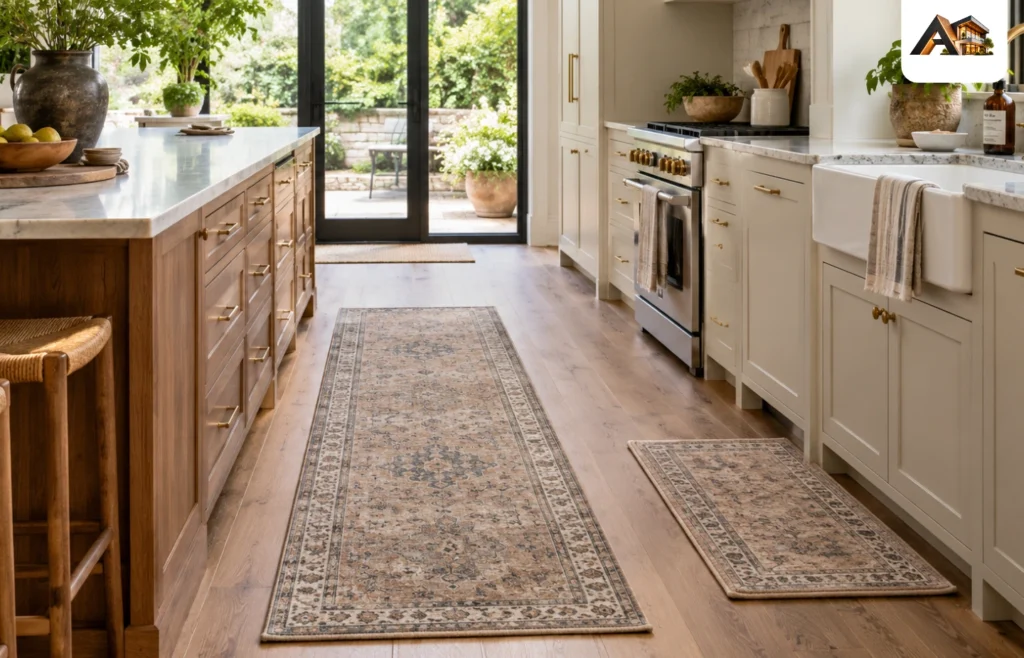
Kitchen rugs can add color and a softer surface underfoot, but they also need to work around spills, crumbs, and moving feet. A practical starting point is a low-profile rug that stays flat, suits your flooring, and has care instructions you can realistically follow.
Choose the location first, then the size and construction. A rug beside the sink has a different job from a runner through a galley kitchen or a rug beneath a breakfast table. This guide helps you decide what belongs where—and whether a rug will make your kitchen easier to enjoy.
Start With the Area You Actually Use
Before browsing patterns, identify what you want the rug to do. Is the sink area uncomfortable underfoot? Does a long aisle feel visually bare? Does the breakfast nook need a clearer connection to the rest of the room?
For one standing spot, consider a small rectangular rug or a purpose-made cushioned mat. For several work areas along the same counter, consider a runner. A thin decorative rug and an anti-fatigue mat serve different purposes; do not assume a washable runner provides substantial cushioning.
You do not need to cover every empty patch of floor. Start with one useful location and leave the rest clear, particularly in a compact kitchen with several doors and turning points.
Choose a Size Around Movement, Not Just Appearance
Measure the usable floor between cabinet fronts, the island, and nearby furniture. Then check what happens when the dishwasher, oven, refrigerator, and lower drawers open.
Common starting sizes include 2 × 3 feet for a small accent rug and 3 × 5 feet for a larger standing area. Narrow kitchens often suit runners. These are shopping options, not rules: the rug must fit the particular work area.
To visualize a size, mark its corners with small pieces of removable tape approved for your floor finish. Walk through the kitchen, stand at the counter, and pull out nearby stools.
For example, a 24-inch-wide runner centered in a 42-inch-wide aisle leaves 9 inches of exposed floor on each side. That calculation helps you picture the proportions; it does not establish a required clearance.
In Front Of The Sink
Position the rug where your feet naturally land while washing dishes. A rug centered perfectly on the cabinet can still feel awkward if you work mainly at one side of a double sink.
Check its relationship to the dishwasher. Include the rug pad when assessing thickness, and make sure the door clears the combined height.
Beside An Island Or Through A Galley
Run the long edge parallel to the cabinets. Choose the length around the working stretch you want to cover, while keeping ends away from awkward thresholds and tight turns.
Avoid overlapping separate rugs to fill an L-shaped route. If two rugs crowd the corner, use one in the busiest standing area.
Beneath A Breakfast Table
Pull every chair out to a comfortable sitting position before measuring. The rug should accommodate the chair legs in use, not simply fit beneath the table when everything is tucked away.
If that footprint interferes with kitchen circulation, leaving the dining floor uncovered may be the more practical choice.
Compare Construction and Care Before Buying
Fiber content matters, but it does not tell you everything. Weave, pile height, backing, and cleaning instructions can make two rugs with the same fiber perform differently.
A flatweave has no upright pile; a low-pile rug has short surface fibers. Both are worth considering where a bulky rug would be inconvenient.
| Option | Why consider it? | What to check |
| Machine-washable polyester rug | Useful when frequent laundering is a priority | Whether the entire rug or only a cover is washable; washer requirements |
| Cotton flatweave | A casual textile option, sometimes machine washable | The specific wash label, drying instructions, and how securely it lies |
| Polypropylene rug | Often available in practical indoor-outdoor constructions | Approved cleaning method; outdoor suitability does not automatically mean machine washable |
| Wool rug | Texture and character for a kitchen where careful maintenance is realistic | Spot-cleaning instructions and potential professional cleaning costs |
| Cushioned kitchen mat | Worth comparing when standing comfort is the main goal | Stable edges, cleanability, floor compatibility, and door clearance |
Rug guides identify washable constructions, durable fibers, and low profiles as useful kitchen considerations, but the individual product’s care label should determine how you clean it.
Jute and sisal need more caution around splashes. These natural plant fibers are moisture-sensitive, so they are not the easiest choice beside a frequently wet sink. If you like their woven appearance, consider a kitchen-suitable synthetic alternative.
Check What “Washable” Actually Requires
A washable kitchen rug is convenient only if you can wash and dry it as directed.
Before ordering, confirm:
- Whether the washable part is the whole rug or a removable cover.
- The washer capacity required for that exact size and construction.
- Whether tumble drying is allowed or air drying is required.
- How the backing or separate pad must be cleaned.
Manufacturers may specify different washer capacities for different rug systems and sizes. Ruggable, for example, publishes a compatibility guide rather than treating every washable rug as suitable for every machine.
Think about drying space as well as washing capacity. A manageable small rug may be more useful than a long runner that you have nowhere to dry.
Water-resistant and washable also describe different features. Neither label alone establishes that spills cannot reach the floor underneath.
Match the Backing to Your Floor
Do not choose a rug pad solely because it promises grip. Check the flooring manufacturer’s instructions for compatible backing materials.
For example, Shaw advises against latex- or rubber-backed mats on its resilient flooring because of possible discoloration. This is a reason to check your specific floor, rather than assume that every non-slip kitchen rug suits every surface.
Use a separate pad when the rug requires one, following its sizing instructions. Avoid adding extra layers beneath a rug system designed to use its own backing.
Check the rug during ordinary use. Sliding, bunching, and curled corners need attention. If a rug continually catches feet or obstructs a mobility aid, removing it is a sensible option.
Bring Color Into the Kitchen Without Overcrowding It
Choose one existing color to connect the rug to the room: a cabinet finish, wall color, backsplash detail, or adjoining upholstery.
In a white kitchen, muted blue or terracotta can introduce warmth and contrast. With natural wood cabinets, olive, cream, or a subdued multicolor pattern can create a softer transition between cabinetry and flooring. These are design directions to sample in your own light, rather than fixed combinations.
Consider pattern scale too. A large central motif may lose its effect in a narrow runner, while a repeating pattern remains visible along its length. With a busy backsplash or patterned floor, a quieter rug can give the room more visual breathing space.
Midtone patterns can make small marks less conspicuous, but that is a visual advantage, not a substitute for cleaning.
Keep the Floor Beneath It Clean and Dry
Build rug care into your existing kitchen routine. Remove crumbs as needed, attend to spills promptly, and follow the product’s instructions for vacuuming and cleaning.
Lift the rug periodically to inspect underneath. After a spill, check the backing, pad, and flooring rather than cleaning only the visible surface. Let washed or damp components dry fully before putting them back together.
There is no useful universal washing schedule for every kitchen. A rug near daily food preparation may need attention sooner than one in a lightly used breakfast nook. Visible soiling, spills, and the care label provide a better guide than an arbitrary calendar.
Frequently Asked Questions
Should kitchen rugs match adjoining living-room rugs?
They can coordinate without matching. Repeating one color or a similar level of pattern can connect an open-plan space while allowing each rug to suit its own function.
Is a vintage rug practical in a kitchen?
It can be, if its condition and cleaning needs suit the location. Consider whether you are comfortable exposing it to spills and paying for appropriate care. For a heavily used sink area, a washable vintage-style rug may be easier to maintain.
Is a kitchen rug necessary?
No. A kitchen can look complete with an uncovered floor. Add a rug when it improves a specific area and the cleaning commitment feels worthwhile.
Choose for the Way You Use Your Kitchen
The right kitchen rug fits your standing and walking areas, works with the floor beneath it, and is manageable to clean. Measure first, check the care label and backing, then choose a color and pattern you enjoy. One well-placed rug is enough to make a useful difference.