Filling a garden bed sounds like the easy part — dump soil in, plant things, done. Then the first heavy rain arrives, the surface sinks six inches, and you’re staring at a half-empty bed wondering where it all went. I’ve been there, and the fix isn’t more soil — it’s filling in the right order and letting the bed settle before you plant.
This guide covers how to fill a garden bed from the bottom up: layering order, how much soil you need, cheap filler options, and the mistakes that cost people a season.
Quick Answer
- The order that works: coarse filler at the bottom (sticks, leaves, straw), then compost and organic matter, then a proper growing mix on top — never plain topsoil alone, and never rocks at the bottom.
- How much soil: multiply length × width × depth. A standard 4×8 ft bed, 12 inches deep, needs about 32 cubic feet — roughly 1.2 cubic yards.
- How to fill a raised garden bed cheaply: use free or nearly free bulk filler for the bottom half — logs, branches, straw, and fallen leaves — and spend your money on the top 6–8 inches of good mix.
- Settling is normal: water each layer as you add it, fill to the brim, and expect the surface to drop a few inches in the first weeks. Top up with compost before planting, and again every spring.
What Is The Right Layering Order When You Fill A Garden Bed?
Think of a filled bed like a lasagna: each layer has a job. The bottom layers take up space cheaply and feed the soil as they break down; the top layer is where your plants live, so that’s where the quality counts.
Here’s the order I use for beds 12 inches or deeper:
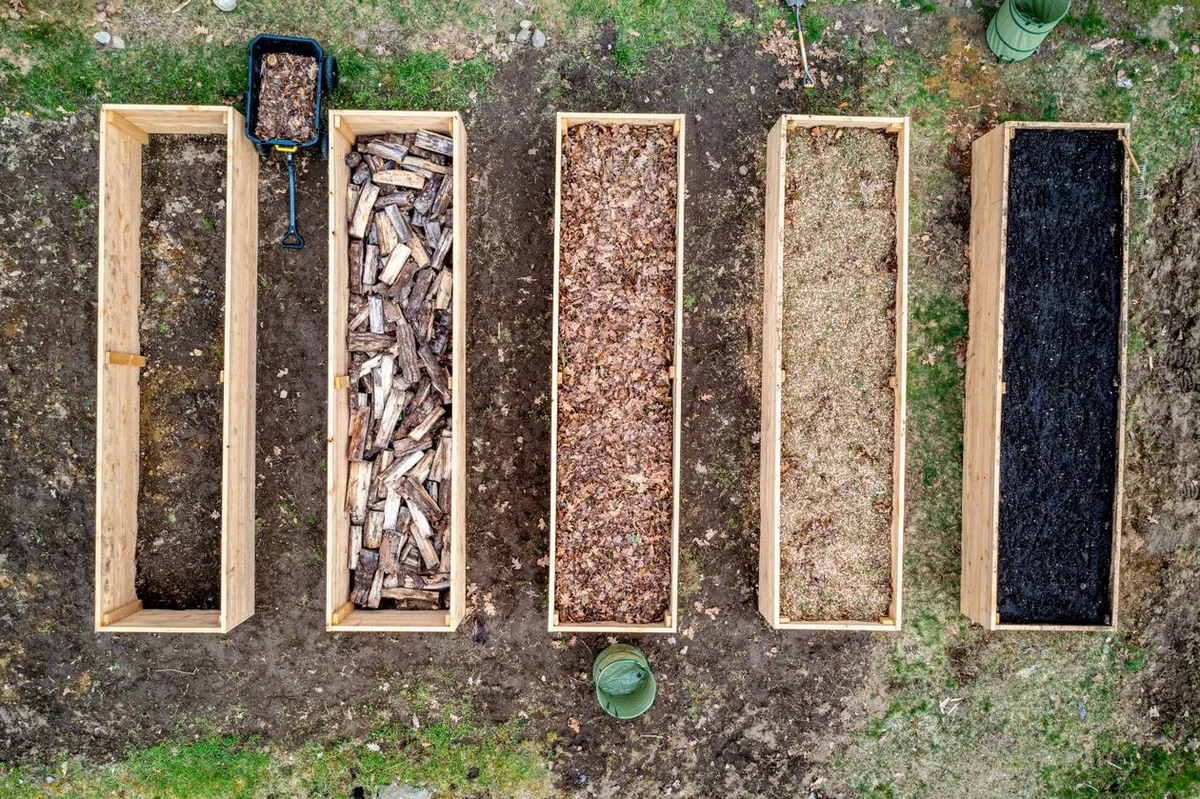
1. Bottom filler (bottom third): small logs, thick branches, twigs, and coarse plant material. This is the hugelkultur-style base — it holds moisture like a sponge as it decays and keeps you from buying soil you don’t need. 2. Middle layer (next third): straw, shredded leaves, grass clippings, and unfinished compost. These break down faster, feeding worms and microbes that do the real soil-building work. 3. Top layer (top 6–8 inches): your growing mix — the best soil mix for raised garden beds, which I’ll break down below. This is the zone roots occupy first, so don’t skimp here.
For shallow beds under 8 inches, skip the woody filler — there’s not enough depth, and roots will hit raw wood before it breaks down. Just use compost and growing mix all the way down.
One common mistake: gravel or rocks at the bottom “for drainage.” It does the opposite — water doesn’t move easily from fine soil into coarse gravel, so moisture pools above the gravel, right where your roots are. Good drainage comes from loose, organic-rich soil, not rocks.
What To Put In The Bottom Of A Raised Garden Bed?
The honest answer: it depends on your bed’s depth and what you can get for free.
Great bottom fillers: small logs and branches (hardwood is best; avoid black walnut, which can inhibit some plants), twigs, straw, shredded cardboard (plain, tape removed), fallen leaves, and grass clippings in thin layers. They break down over one to three seasons, feeding the soil above — you’re not just filling space, you’re building soil that gets better with time.
Fine in moderation: unfinished compost, wood chips, and straw bales broken apart. Wood chips are fine down low, but keep them out of the top few inches — as they decompose, microbes borrow nitrogen from the surrounding soil, which you don’t want happening around seedlings.
Avoid fresh manure (it burns roots and carries weed seeds — it needs months to age), treated or painted wood, plastic sheeting, and household trash. Plastic is a particular trap: it stops drainage and worms, and eventually shreds into pieces you’ll pick out of the soil for years. Plain cardboard blocks weeds underneath and rots away on its own.
On open soil, the bottom layer can be simpler — worms will find their way up. On concrete or a patio, it matters more, because nothing comes up from below and the bed must hold all the moisture and biology itself.
How Much Soil Does A Garden Bed Need?
Worth doing before you order anything, because bagged soil is shockingly expensive in bulk. The formula: length × width × depth in feet gives cubic feet; divide by 27 for cubic yards, which is how bulk suppliers sell it.
| Bed size | Depth | Soil needed (cubic feet) | Approx. cubic yards |
|---|---|---|---|
| 4×4 ft | 12 inches | 16 | 0.6 |
| 4×8 ft | 12 inches | 32 | 1.2 |
| 4×8 ft | 18 inches | 48 | 1.8 |
| 3×6 ft | 12 inches | 18 | 0.7 |
| 2×8 ft | 12 inches | 16 | 0.6 |
With the layering method, you only buy growing mix for the top 6–8 inches — for that 4×8 ft bed, roughly 16–21 cubic feet instead of 32, nearly halving the bill. And always buy about 10–15% extra: soil settles, bags run short, and you’ll want some left for topping up after the first rains.
Bag math: a standard 2-cubic-foot bag covers about 24 square feet at one inch deep, so that 4×8 ft bed at 12 inches would take sixteen bags if filled entirely with bagged mix.
How To Fill A Raised Garden Bed Cheaply
The savings come from the bottom, not the top. Every dollar you save on growing mix is a dollar your plants will notice; every dollar you save on filler is free money.
Free filler most people overlook: autumn leaves (neighbors often give bagged leaves away gladly), straw from a local farm (far cheaper than garden-center bales), wood chips from a tree service (many give them away rather than pay to dump them), and your own prunings. A fallen branch you’d pay to haul away is perfect bed filler.
Buy in bulk, not bags: a cubic yard of bulk compost from a landscape supplier typically costs a fraction of the same volume in bags, and many deliver. Only need a little? Split an order with a gardening neighbor.
Don’t buy “fill dirt” — it’s cheap for a reason: usually heavy clay, full of stones, nearly sterile, and it compacts like brick. Spend your free-filler savings on good compost and growing mix instead.
Compost is your best friend here: a half-finished batch is ideal middle-layer material, and many municipalities give away or sell compost cheaply through green-waste programs — worth a quick search before buying anything.
What Is The Best Soil Mix For Raised Garden Beds?
The best soil mix for raised garden beds isn’t a bag labeled “garden soil” — that’s usually too dense on its own. The blend that consistently grows the best vegetables is roughly:
- 60% topsoil — the mineral base, screened to remove stones and debris
- 30% finished compost — the fertility, the biology, and the water-holding capacity
- 10% aeration — perlite, coarse sand, or pumice, which keeps the mix from compacting
Mixed, it should feel dark, crumbly, and moist — like a wrung-out sponge. Squeeze a handful: it should hold together loosely, then crumble when poked. A sticky ball that won’t break apart means too much clay; dust falling through your fingers means more compost. University extension guidance points the same way — University of Minnesota Extension’s raised bed guide recommends a loose, compost-rich mix for drainage and fertility together, not one or the other.
Bagged “raised bed mix” can be good, but quality varies wildly, and some are mostly wood fines that shrink dramatically as they decompose. Open one bag first — it should look and smell like soil, not mulch. And don’t use pure compost as your growing layer either: too rich, too wet, and it shrinks a lot as it keeps breaking down. The blend is what works.
For the bed-building side of this project — siting, leveling, and assembling the frame itself — our guide on how to build a raised garden bed covers it step by step, and you’ll find more growing guides in the gardening section.
How Do You Water, Settle, And Top Up A Newly Filled Bed?
How you settle the bed decides whether your plants start in a stable home or a sinking one.
Water as you go, not just at the end. Soak each layer thoroughly: it collapses air pockets that would cause sudden sinking later, and kick-starts decomposition. Dry leaves and straw take up surprising amounts of water, so don’t be shy — every layer should be damp, not just the surface.
I fill beds an inch or two proud of the top boards, knowing the surface will drop. After the first good watering and a week or two of rain, check the level; if it’s dropped more than a couple of inches, top up with compost before planting — not more filler, which restarts the settling cycle under your seedlings.
This is the part people forget, and the easiest habit in raised-bed gardening. Every spring, before planting, spread an inch or two of finished compost over the surface and fork it lightly into the top few inches. It replaces what decomposed over winter and feeds the soil biology. Beds that get this annual top-up barely need anything else — the soil genuinely improves year after year.
Mistakes To Avoid When Filling A Garden Bed
Most filling mistakes don’t kill plants outright — they just quietly cost you a season:
- Fresh manure in the planting zone. It burns young roots, smells, and can carry pathogens. Manure needs to be well-rotted — dark, crumbly, and earthy-smelling — before it goes anywhere near growing plants.
- Treated or painted wood as filler. Old fence boards and painted offcuts can leach preservatives and paint chemicals into the soil. Keep them out of food-growing beds entirely.
- Plastic lining on the bottom or sides. It blocks drainage and worms, and it never fully disappears. Cardboard for weed-blocking, yes. Plastic, no.
- Filling only with topsoil. Dense, lifeless, and it compacts into concrete after a few waterings. Topsoil is an ingredient, not a finished mix.
- Planting immediately at the final level. The bed will settle under your plants, exposing roots and leaving stems buried too deep or too shallow. Water, wait a week or two, top up, then plant.
- Skipping the mulch. A couple of inches of straw or shredded leaves on the surface after planting holds moisture, suppresses weeds, and keeps the soil biology fed. Bare soil in a raised bed dries out fast in summer.
Frequently Asked Questions
How Deep Should I Fill A Raised Garden Bed?
Most vegetables do well with 12 inches of good growing mix, with filler below if the bed is deeper. Lettuce and herbs manage in 6–8 inches, but carrots need the full 12 or more. On concrete, add a few extra inches since roots can’t reach native soil below.
Can I Fill A Raised Bed With Just Compost?
You can, but it’s not ideal. Pure compost holds too much water, shrinks significantly as it keeps breaking down, and can be too rich for young seedlings. A blend of topsoil, compost, and something for aeration performs better and stays at a stable level much longer.
How Long Does It Take For The Bottom Filler Layers To Break Down?
Straw and leaves break down within a season; small branches take one to two years, thicker logs three or more. That’s fine — as they decay they release nutrients slowly and hold moisture, so the bed improves while the filler disappears. Top up with compost each spring to replace lost volume.
Do I Need To Line The Bottom Of My Raised Garden Bed?
No, not with plastic or fabric. On soil, nothing is needed — worms and drainage take care of themselves. For blocking weeds underneath, plain cardboard works and rots away naturally; landscape fabric slows worms and root penetration, so cardboard is usually the better call.
How Often Should I Top Up My Raised Garden Bed?
Once a year, every spring, with an inch or two of finished compost — enough to replace what decomposed over winter and keep fertility high. If the level has dropped a lot, top up with a compost-and-topsoil mix rather than compost alone, and check the bottom layers haven’t collapsed into a void.
Fill It Once, Fill It Right
Filling a garden bed properly is a job that pays you back for years. Get the layers in the right order, spend your money on the top few inches, let free filler do the heavy lifting underneath, and give the bed a week to settle before planting. Do that, top up with compost every spring, and you’ll have a bed that grows better soil every single year.