
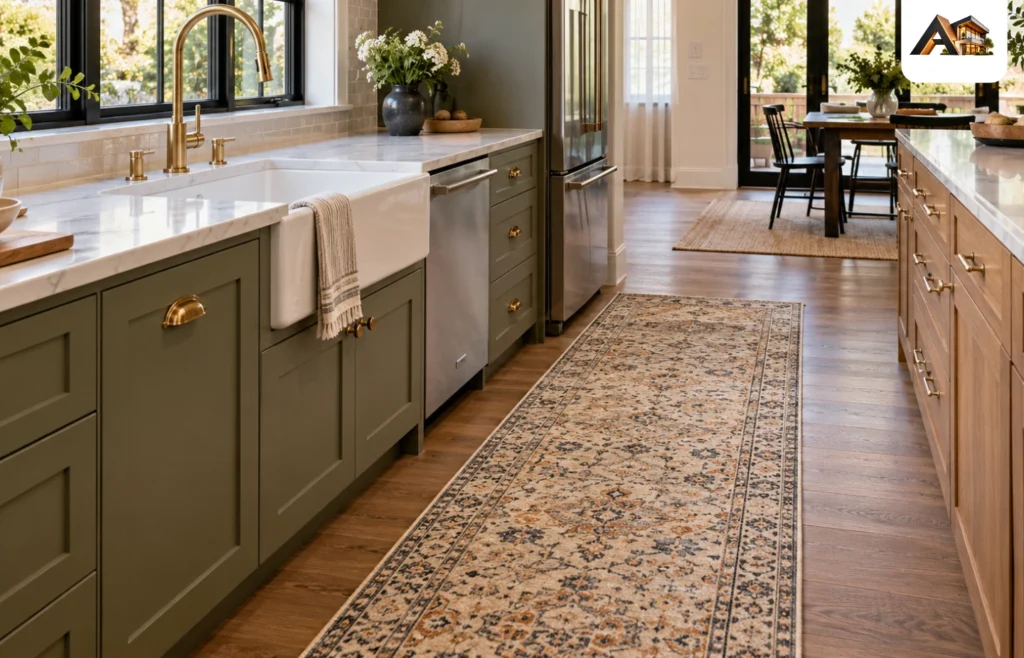
A kitchen runner is a long, narrow rug placed beside a counter, in front of a sink, or along the aisle between cabinets and an island. It adds color and softness to a room filled with hard surfaces, but its usefulness depends on how well it fits your daily routine.
For a busy kitchen, start with a low-profile runner, a cleaning method you can manage, and backing or a rug pad compatible with your floor. Then choose the pattern. A beautiful rug becomes frustrating quickly if it catches the dishwasher door, shifts underfoot, or is too bulky to wash.
This guide explains how to measure your space, compare practical options, and choose a runner that works where you actually stand.
Where Should a Kitchen Runner Go?
Place a kitchen runner along the work area you use most, while keeping doors, turning points, and adjoining walkways clear. The best position depends on your layout and where your feet land during ordinary tasks.
Between an Island and the Cabinets
Run the rug parallel to the island and the facing cabinet run. Centering it within the aisle usually creates a balanced appearance, but check the position from the sink and preparation counter.
If the rug sits so far away that only your heels touch it while washing dishes, shift it toward the working side. In a wider aisle, positioning it closer to the sink can be more useful than keeping it perfectly centered. Ruggable’s kitchen placement guidance makes this same distinction between narrow and wide galley spaces.
Keep the ends out of the route people use to turn around the island. A shorter runner can work better than one that extends into a busy crossing point.
Along a Galley Kitchen
A runner can follow the long axis between two cabinet runs. Look at the entire working aisle, including the refrigerator, dishwasher, and any doorway at the far end.
The rug should lie flat without bunching against cabinet bases. Open appliance doors fully before settling on its position, and check whether you can load the dishwasher without catching the edge under your feet.
In an L-Shaped or Open Kitchen
Start with the longer, frequently used counter run. You do not need a rug along every cabinet.
If the sink occupies a short section and the rest of the floor is mainly circulation space, a small kitchen mat may be a better fit. Avoid overlapping two runners at a corner; choose separate pieces that leave a clear gap, or use one rug in the main work area.
How to Measure for a Kitchen Runner?
Measure the usable floor area before choosing a standard rug size. The full length of the kitchen is less useful than the length of the space where the runner can sit comfortably.
- Measure the aisle width. Take the measurement between the facing cabinet bases or other fixed boundaries.
- Identify the useful length. Mark where the working zone starts and where doorways, turns, or seating begin.
- Map the proposed rug footprint. Use a measuring tape or small pieces of tape approved for your floor finish.
- Rehearse ordinary tasks. Stand at the sink, open the refrigerator, lower the dishwasher door, and walk around the island.
- Check total thickness. Include the rug, backing, and any separate pad when assessing door clearance.
For example, a 30-inch-wide runner centered in a 42-inch aisle leaves 6 inches of exposed floor on each side. That calculation helps you picture the fit; it does not establish a universal clearance requirement.
Likewise, a 7-foot runner placed within a 9-foot usable stretch leaves 1 foot at each end when centered. Whether that works depends on what happens at those ends.
Treat exposed floor borders as a proportion choice, not a rigid rule. The runner should look intentional, cover the area you want to stand on, and stay clear of moving doors.
Before ordering, check the product’s actual dimensions and whether the listed length includes fringe. A nominal size may not tell you everything about its footprint.
Which Kitchen Runner Material Is Most Practical?
Choose the complete rug construction rather than relying on fiber content alone. The face material, weave, backing, edging, and care instructions all affect how it performs.
Flatwoven rugs have no raised pile, while low-pile rugs have a short surface. Both are useful starting points for kitchens because a flatter surface makes crumbs easier to vacuum than a deep, shaggy texture. IKEA’s rug guidance specifically identifies flatwoven designs as practical for kitchen and dining spaces.
| Runner option | Why you might choose it | What to check |
| Machine-washable synthetic runner | Convenient laundering and a wide choice of patterns | Whether the exact size fits your washer and whether the backing is washable |
| Cotton flatweave | A lightweight woven feel, with washable options available | Care label, drying instructions, and whether a separate grip pad is needed |
| Low-pile polypropylene runner | A practical synthetic option for a frequently used space | The specified cleaning method; polypropylene does not automatically mean machine-washable |
| Wool runner | Texture and a more traditional rug appearance | Spill-care requirements and whether you are comfortable with the upkeep |
| Wipe-clean runner or floor mat | A surface suited to quick cleanup | Floor compatibility, edge profile, and how it feels underfoot |
Synthetic fibers are commonly used for durable, easy-care rugs in busy areas, including kitchens. Some cotton rugs are also machine-washable, but size and construction matter; follow the individual product label.
For a splash-prone sink area, favor a product whose care instructions explicitly accommodate regular cleaning. If you love a natural, textured appearance, compare that look with the maintenance it requires before buying.
Long fringe and pronounced surface texture also deserve attention. Think about dropped rice, pet hair, chair legs, and your vacuum—not just how the rug looks in a photograph.
What “Washable” Really Means?
A washable kitchen runner is useful only if washing it is practical in your home.
Some designs go into the machine as a complete rug. Others have a removable cover and a separate base, with different care instructions for each component. Check which part is washable before comparing products.
Also check the recommended washing-machine capacity for the exact rug size and construction. Ruggable, for example, directs buyers to its machine-size guidance rather than assuming every washable rug fits every home washer.
Before buying, answer these questions:
- Can the whole runner be washed, or only its cover?
- Does your washing machine meet the stated requirements?
- Is tumble drying permitted?
- If it needs air drying, where will you hang or lay it?
- Can you manage lifting, drying, and repositioning it regularly?
A shorter, lighter runner can be a better purchase than a larger one that makes every wash inconvenient. Include any separate pad and likely cleaning costs when comparing the total price.
Check the Backing Against Your Kitchen Floor
“Non-slip” describes a grip feature; it does not establish compatibility with every flooring material.
Check your flooring manufacturer’s care instructions before choosing rubber, latex, adhesive grippers, or a separate rug pad. For example, Shaw advises against placing latex- or rubber-backed mats directly on its resilient flooring because they may cause discoloration.
For a runner that needs a pad, choose one intended for both the rug and your floor finish. Follow the recommended sizing so the pad supports the rug without protruding beyond its edges.
After laying the runner, check that it stays flat during ordinary movement. Repeated shifting, curling corners, or buckling need attention. If you cannot keep it stable, remove it from the working aisle.
A runner is optional. A clear floor may suit a narrow kitchen or a household where rug edges interfere with mobility aids.
Choose Color and Pattern Around the Fixed Finishes
Start with the elements you are keeping: cabinets, countertops, backsplash, and flooring. The runner can connect these surfaces or introduce one controlled accent.
For a white kitchen, muted terracotta, blue, olive, or a multicolored traditional pattern can add depth. Repeat one shade in a towel or nearby accessory if you want the color to feel connected.
For wood cabinets, compare the rug against the wood’s undertone. Cream, muted blue, and soft green are useful starting points, but view samples in your own light.
For patterned tile or strongly veined countertops, try a quieter rug. A restrained stripe, small motif, or tonal design gives the room another layer without competing with every surface.
For dark flooring, a medium-toned runner can create definition without the strong contrast of a pale cream rug. Very dark solid colors may make pale crumbs and pet hair particularly noticeable.
A mixed-tone pattern can make everyday marks less conspicuous, but it does not reduce the need for cleaning. Choose a design you like when it is clean, rather than relying entirely on its ability to disguise spills.
Kitchen Runner or Anti-Fatigue Mat?
Choose a runner when your priority is adding texture, pattern, and a softer surface across a longer area. Consider a purpose-designed cushioned kitchen mat when your main concern is how the floor feels during stationary tasks at the sink or preparation counter.
A thin decorative runner should not be assumed to provide the same cushioning as an anti-fatigue mat. Compare the actual construction and feel.
Avoid stacking a runner over a cushioned mat unless the products are specifically designed to work together. Extra layers can create an uneven edge or allow movement between them.
If only one small standing area needs attention, a single mat may solve the problem more neatly than a full-length runner.
Keep the Runner—and the Floor Beneath It—Clean
Build care around how your kitchen is used rather than following an arbitrary washing schedule.
Remove crumbs and grit with the vacuum setting recommended for the rug. Blot spills promptly, then follow the manufacturer’s stain-treatment instructions. Avoid assuming that a cleaning solution suitable for one rug will suit another.
Lift the runner when liquid reaches underneath it. Clean and dry the floor, backing, and pad before putting everything back. An absorbent surface can conceal moisture rather than eliminate it.
After washing, check the edges and backing before returning the rug to service. Let it dry fully, lay it flat, and confirm that it still sits securely.
Frequently Asked Questions
Does a kitchen runner need to match the dining room rug?
No. In an open layout, a shared color or similar visual mood is usually enough. Different pattern scales can help the rugs relate without making the rooms feel overly coordinated.
Can a hallway runner be used in a kitchen?
Yes, if its care requirements, thickness, backing, and dimensions suit the kitchen. The room label matters less than how the rug handles the conditions where you plan to place it.
Should a runner be the same length as the kitchen island?
It does not have to be. Use the working aisle and its turning points to determine length. A runner shorter than the island can be more practical when the ends of the island are busy circulation routes.
Is a kitchen runner waterproof?
Do not assume so. Washable, stain-resistant, water-resistant, and waterproof describe different properties. Check the exact product specification and clean up liquid underneath the rug whenever a spill reaches the floor.
Choose for the Way You Use the Kitchen
The right kitchen runner fits your working area, stays flat, and has a cleaning routine you can realistically maintain. Measure first, confirm floor compatibility and appliance clearance, then choose the color and pattern. Those checks make it much more likely that the runner will remain a useful part of the room.